Digital Product Pricing: 7 Strategies That Maximize Revenue
You spent 200 hours building a course. You agonized over every module, re-recorded three lessons, and polished the workbook until it was perfect. Then you slapped a $19 price tag on it.
That's not modesty. That's self-sabotage.
Pricing is one of the highest-leverage decisions a digital product creator makes, and it is easy to get wrong. The price touches every single sale. One bad price can kill a great product.
This guide covers seven practical pricing strategies you can apply and test on Gumroad, Whop, Skool or your own site. Not theory. Not MBA jargon. Tactics you can set up this week, then check against your own sales. For market context, InsightRaider tracks 500K+ products across Gumroad, Whop and Skool with modeled sales estimates.
Why Most Creators Underprice Their Products
There is a good chance you're charging too little. Low prices feel safe, but they demand volume you may never get.
The math is simple but counterintuitive. In a hypothetical example, a $79 product that sells 200 units makes $15,800. A $12 product needs to sell 1,317 units to match that. Guess which one is harder to achieve?
Why does underpricing happen?
- Imposter syndrome. You compare yourself to established creators and feel your product isn't "worth" a premium price. It is. Get over it.
- Cost-based thinking. You think "it only took me two weeks to make, so it can't be worth $99." But buyers don't pay for your time. They pay for the outcome.
- Fear of zero sales. A $19 price feels "safe." But safe pricing leads to slow death by low margins and high support volume.
- No competitive data. You have no idea what competitors charge or sell, so you default to the lowest price you've seen. That's not strategy, that's panic.
The fix? Stop guessing and start using data. Every strategy below helps you capture the value you're already creating.
Before selecting a price, compare offers solving the same customer problem, with the same billing period and level of support. Our analytics and market research tools comparison separates your own sales reporting from competitor estimates, so you can choose evidence that fits the decision. Use those estimates to investigate an offer, then test pricing with your own buyers.
Strategy 1: Price Anchoring (Show Premium First)
Anchoring is one of the most powerful cognitive biases in pricing psychology. The first number someone sees becomes the reference point for every number that follows.
How It Works
Instead of showing your $49 product in isolation, you present it alongside a $199 option first. Suddenly $49 doesn't feel expensive. It feels like a bargain.
Hypothetical example: A Notion template creator restructures their sales page to lead with a $149 "Done-For-You Setup" package at the top. Below it, the $39 template appears. Nothing changes except the order of information on the page, so any change in the $39 conversion rate over the following weeks is easy to attribute.
How to Apply It
- On your sales page: Lead with the premium option. Show the most expensive tier first in your pricing table.
- In your copy: Mention the value of outcomes early. "This system saves freelancers $5,000/year in lost billable hours" makes a $79 price feel trivial.
- With strikethrough pricing: Show original value ($197) crossed out next to your price ($49). This works especially well during launches.
Anchoring isn't about tricking people. It's about giving buyers the context they need to understand the value of what you're offering.
Strategy 2: Tiered Pricing (Good / Better / Best)
Tiered pricing is one of the most direct ways to raise average order value. A single price forces every buyer into the same deal: the price-sensitive buyer leaves, and the buyer who would have paid more pays less. If you're selling at one price, test whether a second and third tier capture both.
The Psychology
When faced with three options, most buyers gravitate toward the middle. It feels like the rational choice: not the cheapest (which feels like you're missing out), and not the most expensive (which feels risky). This is called the compromise effect, a well-documented pattern in behavioral economics.
The Ideal Structure
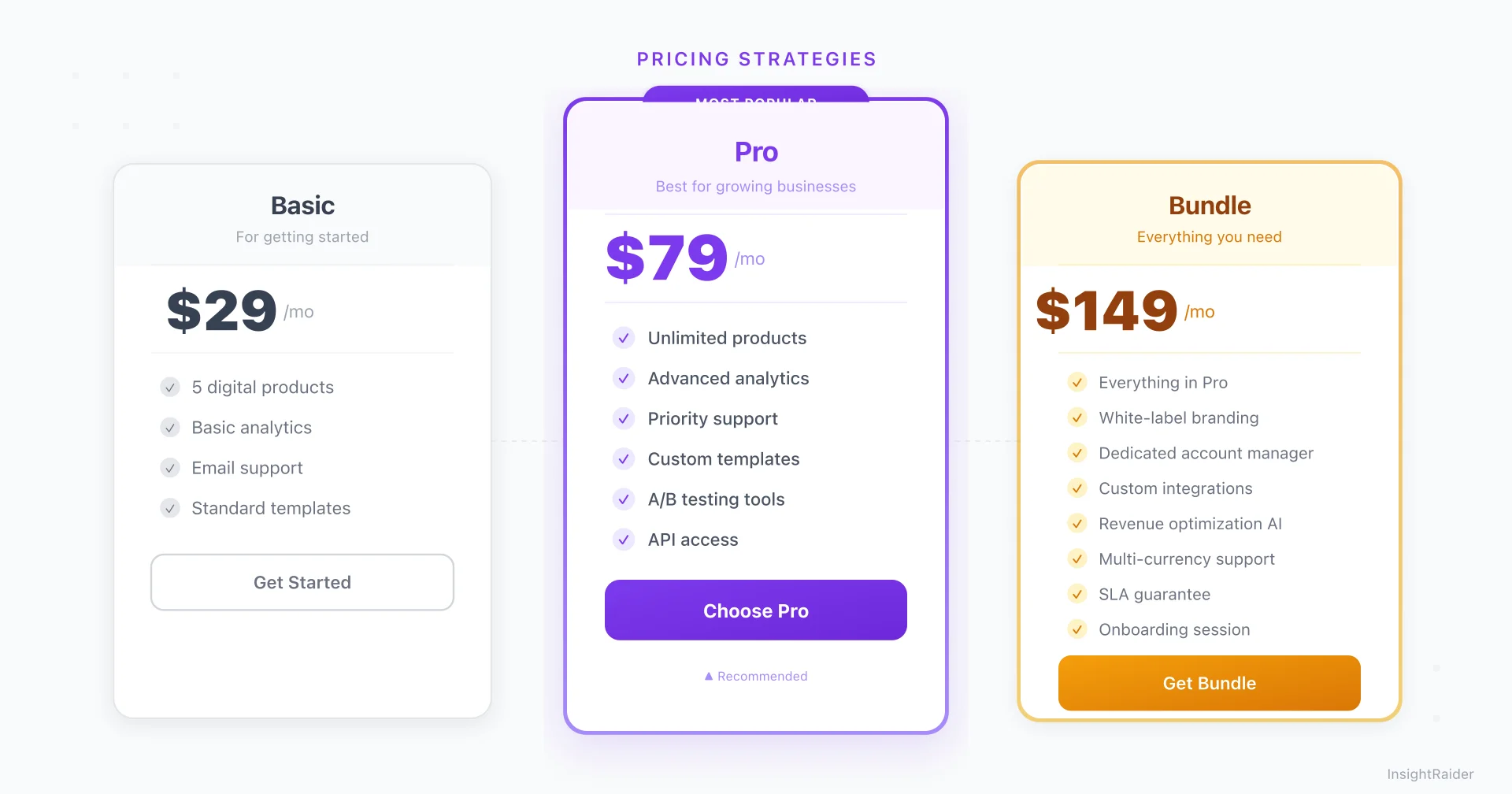
| Tier | Purpose | Pricing Sweet Spot |
|---|---|---|
| Basic | Entry point, captures price-sensitive buyers | 0.5x your target price |
| Pro (highlight this) | Your main offering, best value | 1x your target price |
| Premium | Anchors the Pro tier, captures high-value buyers | 2-3x your target price |
Example for a course creator:
- Basic ($29): Course videos only
- Pro ($79): Course + templates + community access (Most Popular)
- Premium ($199): Everything + 2 live group coaching calls + personal review
Design your tiers so that most buyers choose Pro. The Basic tier exists to make Pro look like a steal. The Premium tier exists to anchor the Pro price and capture the smaller group of buyers willing to pay more. Check your own order mix after a few weeks: if Basic dominates, the gap to Pro is not clear enough.
Pro Tip
Add a visual badge or "Recommended" label to your middle tier. Only call it "Most Popular" if your own sales records say so. It's a five-minute change that is easy to measure.
Strategy 3: Pay-What-You-Want (When It Works)
Pay-what-you-want (PWYW) has a reputation for leaving money on the table. And in many cases, that reputation is earned. But when deployed strategically, PWYW can serve goals that fixed pricing cannot.
When PWYW Works
- You have a large, engaged audience. Followers who trust you tend to pay fairly, or even generously.
- Your product serves as a lead magnet. You're optimizing for email subscribers or community members, not immediate revenue.
- You set a meaningful suggested price. The suggested price works as an anchor. A $0+ default invites $0 payments; a realistic suggested price gives buyers a reference point.
When PWYW Fails
- You have no audience yet (strangers default to free or near-free)
- Your product is a premium offering (it signals low confidence)
- You don't set a minimum price or suggested price
How to test it: run PWYW with a suggested price (say $25) against a flat fixed price (say $19) and compare total revenue over the same period, not the number of downloads. Expect it to work best when buyers already know and trust your work, for example through a newsletter.
Bottom line: Use PWYW for audience building or if you have a loyal following. For everything else, use fixed pricing with tiers.
Strategy 4: Launch Pricing and Scarcity
Every product launch is a pricing event. Smart creators use this window to create urgency and maximize early sales, which then fuel social proof for full-price sales.
The Launch Pricing Playbook
Phase 1: Early Bird (Days 1-3) Offer 40-50% off your regular price. Cap it at a specific number of buyers (e.g., "First 50 buyers get founding member pricing").
Phase 2: Launch Week (Days 4-7) Reduce the discount to 20-30%. Emphasize that early bird pricing is gone and that this is the last discount window.
Phase 3: Full Price (Day 8+) Move to regular pricing. Use testimonials and reviews from early buyers to justify the full price.
Why This Works
- Real scarcity drives action. "First 100 buyers" with a live counter creates genuine urgency. People hate missing out on a deal they know others got.
- Early buyers become advocates. They feel like insiders who got a deal, making them more likely to leave reviews and share with their network.
- You build pricing momentum. Starting low and increasing makes each subsequent buyer feel the product is gaining value, not losing it.
What to Avoid
- Fake scarcity. If you say "only 50 copies at this price" but sell 500, people notice. And they tell others. Your reputation is worth more than a few extra sales.
- Perpetual discounts. If your product is always "on sale," you've trained your audience to never pay full price. JCPenney learned this the hard way. Don't repeat their mistake.
Strategy 5: Bundle Pricing
Bundling is the quiet revenue multiplier that most creators overlook. Instead of selling five products for $29 each, you sell the bundle for $99 and make more per transaction while giving buyers a perceived discount.
How to Structure a Bundle
The Value Stack Method:
- List every component with its standalone value
- Total the standalone values
- Price the bundle at 40-60% of the total
Example:
- Notion Client Management Template ($29 value)
- Freelancer Invoice System ($19 value)
- Project Tracker Template ($29 value)
- Client Onboarding Checklist ($15 value)
- 45-minute Video Walkthrough ($29 value)
Total standalone value: $121 Bundle price: $59
The buyer feels like they're getting a deal. You're getting $59 instead of the $29 they would have spent on a single template. Everyone wins.
Bundle Pricing Tips
- Always show the math. Display each component's individual value alongside the bundle price. The savings should be immediately obvious.
- Create bundles from existing products. This is pure profit. No additional creation cost, just packaging.
- Offer the bundle and individual products simultaneously. Some people only want one item. Let them buy it. But make the bundle so attractive that most choose it.
A bundle is one of the cheapest pricing tests you can run: no new product, no new traffic. Compare average order value before and after, and check that the bundle adds orders instead of only replacing single-product sales. Do this today. Not next week. Today.
Strategy 6: Subscription and Recurring Revenue Models
One-time sales are a treadmill. You sell today, and tomorrow you start from zero. Subscriptions change the equation entirely.
When Subscriptions Make Sense
- Your content updates regularly. Monthly templates, prompt libraries, asset packs, or curated resources.
- You provide ongoing access. Community memberships, group coaching, or live workshops.
- Your product is a tool, not a one-time purchase. Systems that people use monthly rather than consume once.
Pricing Subscription Products
| Model | Price Range | Best For |
|---|---|---|
| Monthly | $9-29/month | Lower commitment, easier first purchase |
| Annual | $79-249/year | Higher LTV, lower churn |
| Lifetime | $199-499 one-time | Cash flow boost, attracts deal-seekers |
The annual discount play: Offer monthly at $19/month or annual at $149/year (save 35%). Buyers who choose annual give you cash upfront and stay committed for 12 months, which removes monthly churn for that period.
The Hybrid Model
Many top creators combine one-time and recurring revenue:
- One-time product: $79 course
- Monthly membership: $19/month for ongoing templates, Q&A, and updates
- Upsell path: Course buyers get the first month free, then some of them stay as paying members (track that conversion rate yourself)
This approach gives you immediate revenue from the course sale and a growing recurring base from members. For a complete playbook on building predictable monthly income, see our guide on recurring revenue with digital products.
Strategy 7: Geographic Pricing (Purchasing Power Parity)
If you sell internationally and you're not using geographic pricing, you're leaving significant revenue on the table.
Average incomes differ several-fold between countries. A $79 product that's an impulse buy for a software engineer in San Francisco can be a serious expense for a developer in Lagos.
How Geographic Pricing Works
Offer regional discounts based on purchasing power:
- Tier 1 (US, UK, Canada, Australia, Western Europe): Full price
- Tier 2 (Eastern Europe, Middle East, East Asia): 20-30% discount
- Tier 3 (South Asia, Africa, Latin America): 40-60% discount
Implementation
Platforms like Gumroad support discount codes. You can create region-specific codes and share them on your sales page with a note: "We offer purchasing power parity pricing. If you're based in a lower-income region, use code PPP40 for 40% off."
Some creators automate this with tools that detect the buyer's IP and display adjusted pricing automatically.
Why It Works
- You capture markets you were losing entirely. Someone who would never pay $79 will happily pay $39.
- Goodwill compounds. Buyers from emerging markets become loyal advocates. They share your products in local communities, creating organic growth.
- Revenue is additive. These are sales you weren't going to make at full price. Every discounted sale is pure incremental revenue.
A word of caution: Some buyers will use VPNs to access lower prices. Accept this as a cost of doing business, and compare the extra regional sales against the full-price sales you lose to arbitrage.
How to Test Prices: A/B Testing Approaches
All of the strategies above come with a caveat: what works for one audience might not work for yours. That's why testing is non-negotiable. Don't guess. Test.
The Simple Price Test
- Pick two prices (e.g., $39 vs $59)
- Run each for 2-4 weeks with equal traffic
- Compare total revenue, not conversion rate
This is critical: a lower price might convert better but generate less total revenue. Always optimize for dollars, not percentages.
What to Test First
Prioritize tests by impact:
- Price point (biggest lever: test 30-50% swings, not $1 differences)
- Number of tiers (one option vs. three tiers)
- Anchor price (changing the premium tier price to shift mid-tier conversions)
- Bundle vs. individual (does bundling increase AOV?)
- Annual vs. monthly framing (which converts better for subscriptions?)
Sample Size Matters
Don't declare a winner after 20 sales. A common rule of thumb is at least 100 transactions per variant before drawing conclusions. If your volume is low, run tests for longer rather than stopping early. Patience pays.
Tools for Testing
- Gumroad: Use separate product links for each variant and split traffic manually or through your email list. If you are choosing a platform, our Gumroad vs Systeme.io comparison covers the pricing features of each.
- Your own site: Experimentation tools like PostHog let you A/B test pricing pages.
- Email segmentation: Send different pricing to different email segments and compare results.
How InsightRaider Helps You Price With Confidence
Every strategy in this article works better when you have data. And the most important question is this: what are your competitors charging, and how well are those offers selling?
This is exactly what InsightRaider is built for.
What You Can Do With InsightRaider
- Compare relevant offers on Gumroad, Whop and Skool. Estimates and observation dates vary; they do not reveal audited competitor revenue.
- Compare pricing across competitors in your niche to understand the market range
- Spot possible pricing gaps where few offers compete (e.g., a $50-80 range with few products in your niche)
- Track pricing changes over time to see if competitors are raising or lowering prices
- Compare modeled estimates by price band across similar products in your category
Instead of guessing that your product should cost $29 because "that's what feels right," you can check whether comparable offers in your niche sit at $49-79, then test a higher price with your own buyers. That can change your pricing decision entirely.
Pricing without data is gambling. Pricing with data is strategy.
Your Pricing Action Plan
Pricing isn't a one-time decision. It's an ongoing optimization. Here's what you do, starting now.
This week:
- Audit your current price. Is it based on data or feelings? Be honest.
- Pick one strategy from this article to implement first (tiered pricing is the quickest win)
- Research competitor pricing in your niche using InsightRaider
This month: 4. Implement tiered pricing if you haven't already 5. Set up your first A/B price test 6. Consider geographic pricing if you have international buyers
This quarter: 7. Analyze results and adjust 8. Add a bundle option to your product line 9. Explore a subscription component for recurring revenue
Creators who charge more aren't necessarily better. They understand the psychology of pricing and they let data guide their decisions. For a step-by-step look at the path to $10K/month, see our breakdown of going from zero to $10K selling infoproducts.
Your product is worth more than you think. Stop leaving money on the table.
Pricing without data is gambling. InsightRaider shows you what competitors charge, modeled estimates of how their offers sell, and where pricing gaps may sit in your niche. Compare offers and set your price with evidence, not guesswork.
Prices, percentages and unit counts in this guide are worked examples or rules of thumb, not measured averages. InsightRaider figures are modeled estimates; see the estimation methodology.
Got more questions? Check out our data-driven answers: