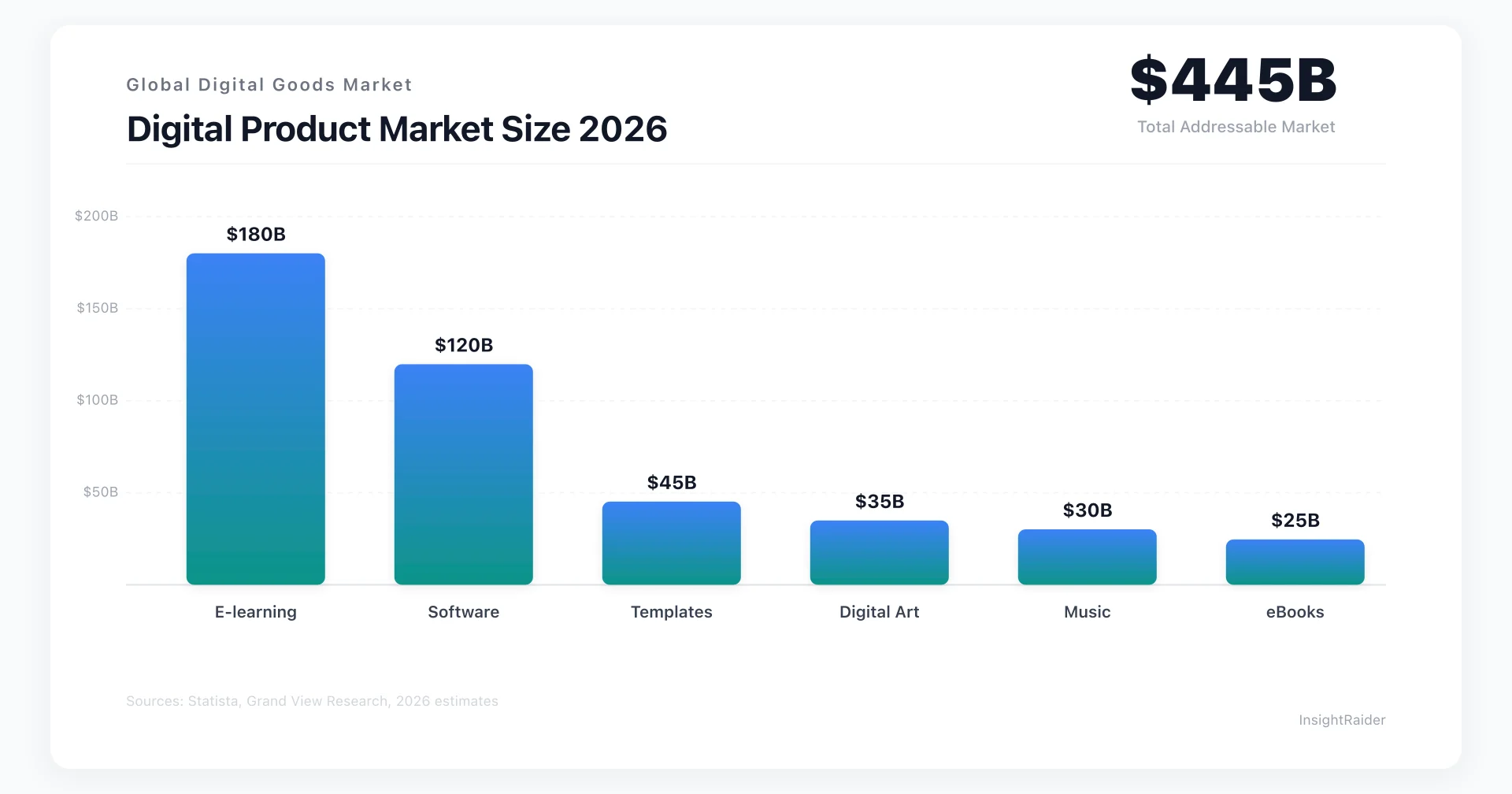
The digital product market in 2026 isn't some emerging side hustle. Yet most "market size" articles recycle the same vague projections from old reports. They quote a single number, slap a growth percentage on it, and call it a day.
That's useless to you.
We take a different approach. Instead of one headline figure, this guide breaks the market down by category, platform and creator tier, and shows where InsightRaider's modeled data on 500K+ products across Gumroad, Whop and Skool can help you research a niche, and where it can't.
The Creator Economy in 2026: Why Digital Products Stand Out
Industry reports put the creator economy in the hundreds of billions of dollars, but those totals mix sponsorships, ad revenue, brand deals and products. Digital products (courses, ebooks, templates, software tools and paid communities) are only one slice, and no public source measures that slice precisely.
Why digital products specifically? Three structural tailwinds.
First, margin superiority. A sponsorship deal pays once. An online course can keep selling with near-zero marginal cost. Creators are waking up to the fact that owning a product beats renting an audience to advertisers.
Second, platform maturity. Selling a digital product in 2020 required stitching together five different tools. In 2026, platforms like Gumroad, Systeme.io, Whop, and Teachable offer end-to-end infrastructure for listing, payment, delivery, and marketing.
Third, buyer behavior shift. Many buyers prefer learning from individual practitioners over institutions. A $49 course from someone who built the thing can beat a $4,900 bootcamp from a company that teaches it secondhand.
The result: a growing number of creators treat products, not ads, as their main revenue line. How fast each category grows is a question to answer niche by niche, with dated observations, rather than with a single industry-wide percentage.
Revenue Breakdown by Niche Category
Not all digital products are created equal. The clearest category view we can source comes from our State of Gumroad 2026 dataset: InsightRaider modeled estimates for 146,271 Gumroad products observed from January to April 2026, totaling $206M in tracked revenue. In that dataset, Software Development leads with $65.8M (about 32% of tracked revenue), followed by Business & Money at $15.4M and 3D at $13.9M. These are estimates built from public signals (see the methodology), not audited sales, and they cover Gumroad only.
The five product formats below cut across those categories.
Online Courses
Online courses remain one of the most visible categories. Creators justify higher prices by adding production value: video, community access and live sessions. In the State of Gumroad 2026 dataset, courses listed on Gumroad have an average price of $95.74.
Common course verticals:
- Business and entrepreneurship
- Technology and programming
- Health, fitness, and wellness
- Creative skills (design, writing, music)
- Personal development and productivity
The important detail: as mainstream categories get crowded, creators find room in hyper-specific verticals like "data analytics for nonprofit managers" or "photography for real estate agents." Specificity beats generality. The generic course is a hard sell.
Templates and Digital Assets
Templates, presets, design assets, Notion systems, and spreadsheets have become a major product format. Three years ago, few creators thought of them as a business.
What happened? The rise of "build once, sell forever" economics attracted a new wave of creators who aren't teachers or course builders. They're practitioners who package their workflows into downloadable products.
Template sub-categories worth researching:
- Notion and productivity templates
- Design assets (Figma, Canva, UI kits)
- Business documents and spreadsheets
- Code templates and boilerplates
- Photo/video editing presets
The math is simple but the execution is not. The winners differentiate on specificity and design quality.
Ebooks and Written Guides
Ebooks are the oldest digital product format, and they aren't going anywhere. But the market has split into two tiers.
Tier 1: Premium guides ($29-99). These are substantial works, often 100+ pages, with frameworks, templates, and actionable systems. They compete with courses on value but appeal to buyers who prefer reading over watching videos.
Tier 2: Low-cost ebooks ($5-19). These usually serve as lead magnets or impulse purchases. Most creators use them as entry points to higher-ticket products rather than standalone profit centers.
Here's the blunt truth: if you're writing an ebook in 2026, price it like a premium product or use it as a funnel. A $9.99 standalone ebook is hard to sustain unless you have strong organic traffic.
Software Tools and SaaS
Creator-built software (browser extensions, micro-SaaS tools, no-code apps, plugins) is the youngest format. On Gumroad, it is also the largest category by modeled revenue in the State of Gumroad 2026 dataset, as shown above.
The playbook: a creator identifies a painful workflow in their niche, builds a simple tool to solve it (often using no-code platforms), and sells it to their existing audience. A subscription model means these products can compound over time.
Notable sub-categories:
- No-code apps and tools
- Browser extensions and plugins
- Spreadsheet-based tools with automation
- API integrations and workflow connectors
- AI-powered micro-tools
The barrier to entry is higher (you need technical skills or a no-code builder), but so is the potential reward.
Paid Communities and Memberships
Paid communities are the hardest digital product to build and the stickiest once you succeed. Churn is the constant enemy: you need a steady inflow of new members or exceptional retention.
Common community models:
- Mastermind groups: highest price per member, smallest scale
- Skill-based communities: a balance of scale and retention
- Content libraries with community: largest member counts, highest churn risk
The trend to watch: hybrid models. Many creators sell a course as the entry point, then offer a community for ongoing support, so members join with a concrete goal.
Growth Rates: Where the Momentum Is
Not every niche grows at the same pace. Pick wrong and you're swimming upstream.
There is no reliable public series of category-level growth rates for digital products, so treat any single "+X% per year" figure with suspicion, including old versions of this article. A better method is to compare dated observations of the same products and niches: new listings, review counts and price changes between two checks.
The trade-offs are clearer than the percentages. Tools and templates are fast to ship and easy to bundle. Courses address the broadest learning demand. Communities offer recurring revenue if you can hold retention.
Across categories, buyers pay more for products that deliver specific, measurable outcomes. For a deep dive into how to price for that, see our guide to digital product pricing strategies.
Platform Landscape: Where the Revenue Lives
The digital product ecosystem is fragmented across dozens of platforms, and none of them publishes comparable market-share data.
Gumroad remains a default for indie creators selling one-off digital products (templates, ebooks, guides). Its simplicity is its strength: low setup friction, a 10% + $0.50 fee on direct sales, and a creator-first brand identity.
Teachable is concentrated almost entirely in courses. It's a go-to for creators building course businesses with structured funnels.
Systeme.io takes an all-in-one approach (funnel builder, email marketing, course hosting, membership sites) that appeals to creators who want a single tool.
Whop carved out a position in the community and subscription space. Its Discord-native approach resonates with younger creators.
Other platforms (Podia, Payhip, Lemon Squeezy, Stan Store, Beehiiv for paid newsletters, Kajabi) make up a long tail, often optimized for particular product types.
The platform trend to watch: vertical specialization. Generic "sell anything" platforms compete with platforms purpose-built for specific product types. Whop for communities. Teachable for courses. Lemon Squeezy for software licenses. Creators are choosing the tool that fits their product, not the other way around.
What the Data Can Say About Creator Revenue
Market size numbers are impressive. Per-creator revenue numbers are sobering. Don't skip this section.
The State of Gumroad 2026 product estimates do not establish a median monthly income for creators. That calculation would require aggregating all products by seller over a known revenue period. The public source archive does not record that period, so we cannot infer how much the typical creator earns per month. The top 1% of products capture 77.3% of tracked estimated revenue, a product-level concentration figure rather than a measure of creator income.
But there are crucial caveats.
Products are not creators. One seller can have several listings. Listing-level estimates cannot be treated as seller-level earnings; use documented sales over a defined period when setting an income target.
Revenue isn't evenly distributed across experience levels. Digital products reward consistency, iteration, and audience building, as illustrated in our Gumroad creator success story.
Niche selection matters enormously. A B2B product often has buyers who expense the purchase or see direct ROI. A course on "sales pipeline management for SaaS companies" can outperform a course on "how to be more creative," even with a smaller audience.
The uncomfortable truth: most digital product ventures fail not because the market is too small, but because creators pick the wrong niche, price too low, or quit before their product gains traction. If niche selection is your bottleneck, our guide on how to find a profitable niche gives you a repeatable framework. This is a market-intelligence problem, not a market-size problem. And that's the problem InsightRaider is built to help with.
Where the Opportunity Lies for New Creators
If you're entering the digital product market in 2026, a few directions are worth testing. Follow the evidence, not your feelings.
Underserved niches with high willingness to pay
The most crowded markets (generic productivity, broad fitness, beginner coding) are tough for newcomers. The opportunity is in specific professional niches where buyers expense purchases or see direct ROI.
Niche ideas worth investigating:
- Compliance training for specific industries (financial services, healthcare)
- Operations templates for e-commerce brands doing $1M-10M/year
- AI workflow automation for legal professionals
- Data visualization for academic researchers
- Client management systems for freelance consultants
These niches sound boring. That's precisely why they deserve a look. Boring is where the money hides. For a curated list of categories to research right now, see our breakdown of the most profitable niches in 2026.
The "second product" gap
Many creators never launch a second product. The opportunity isn't just in entering the market but in building a portfolio. One ebook, one course, one template, one community, all serving the same niche audience. A product ecosystem gives each buyer a next step, and gives you more than one way to earn from the same audience.
International markets
Most English-language digital products are written with a US audience in mind. But buyers in the UK, Australia, Canada, Germany, and the Nordics can have comparable willingness to pay and less competition for localized content. Adapting a product for a specific market (not just translating, but localizing examples, case studies, and cultural references) is a test worth running.
The premium pricing frontier
A counterintuitive idea worth testing: premium pricing ($149-499) can attract serious buyers, justify higher marketing spend, and filter out refund-prone customers. Measure your own refunds and conversion before and after a price change rather than relying on someone else's averages. Stop underpricing by default.
How InsightRaider Supports Market Research
Every section in this article starts from a hard question: how big is this market, how fast is it growing, and where should I compete?
InsightRaider helps you investigate those questions with dated product observations, not a yearly headline.
Research comparable offers. Inspect public product signals on Gumroad, Whop and Skool. Check available observation dates before comparing periods; a modeled estimate does not establish the size or monthly revenue of an entire market.
Competitor revenue estimates. Compare modeled revenue estimates for products in your niche to understand the likely range and what top performers do differently. Read the methodology for how estimates are built and where they can be wrong.
Trend checks. Compare dated observations of a niche to see which products are gaining reviews or new listings, and which categories look quieter.
Pricing research. See the distribution of listed price points in a niche before you pick yours. Stop guessing what to charge.
The digital product market is large, but a market total doesn't tell you whether your product will sell. The difference between creators who grow and those who stall is rarely talent or luck. Often, it's information.
Creators who understand their market, validate demand before building, study their competitors, and price with evidence make better decisions at every step. That's what InsightRaider is built to support.
A big market still has room only in the right niches. InsightRaider breaks down modeled estimates by category, sub-niche, and individual product so you can see where demand shows up. Explore comparable offers and zoom in from market-level research to your specific opportunity.
Got more questions? Check out our data-driven answers: