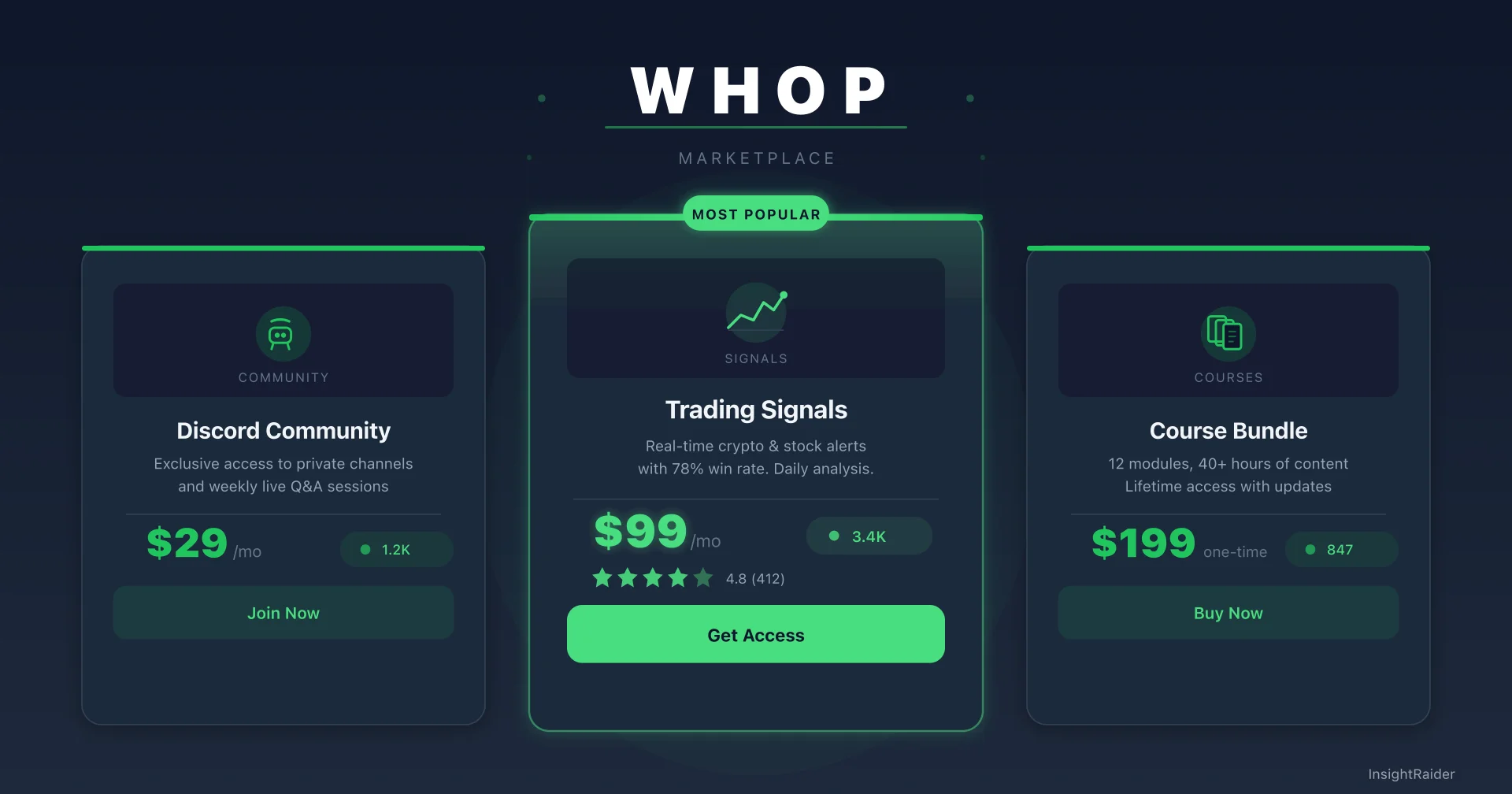
How to Launch and Sell Digital Products on Whop
Whop has become a serious channel in the digital product market. Some sellers treat it like another Gumroad and struggle. The ones who understand what makes Whop different give themselves a real edge.
This guide covers what works, what doesn't, and the steps to go from zero to your first sales.
What Is Whop and Why Should You Care?
Whop is a marketplace and storefront for digital products, communities, and software access. Think Shopify meets Discord, with a built-in audience ready to spend.
Here's what actually separates Whop from everything else:
The marketplace is the product. On Gumroad, you drive your own traffic. On Whop, the marketplace sends buyers to you. Discovery algorithm, categories, trending lists, search. People come to Whop looking to spend money, same way they browse Amazon.
Recurring revenue is native. Other platforms bolt subscriptions on as an afterthought. Whop was built around memberships and recurring access from day one. That changes how you think about pricing and product design.
Community and product are merged. Your Whop includes chat rooms, courses, file hosting, software access, and webhooks -- all in one place. Buyers don't just get a file download. They get an experience.
Platform comparison:
| Feature | Whop | Gumroad | Patreon |
|---|---|---|---|
| Built-in marketplace | Yes | Limited | No |
| Buyer discovery | Algorithm-driven | Minimal | None |
| Recurring revenue | Native | Add-on | Native |
| Community features | Built-in | No | Limited |
| Transaction fees | 0% platform fee + 2.7% + $0.30 processing | 10% + $0.50 + 2.9% + $0.30 processing | Platform fee + processing (check current plans) |
| Product types | Memberships, software, courses, files | Files, courses | Memberships |
No platform fee, just 2.7% + $0.30 card processing on domestic sales. That alone makes Whop one of the cheapest platforms to sell on. Combined with marketplace traffic, it's a no-brainer, if your product fits the audience. For a deeper platform comparison, see our Gumroad vs Systeme.io breakdown.
What Sells Best on Whop
Not every digital product thrives here. Whop's audience skews young, tech-savvy, hustle-oriented. Understand this or waste your time.
Tier 1: High Performers
Private communities and groups
Whop's bread and butter. Paid communities around trading, crypto, sports betting, reselling, and entrepreneurship dominate the charts. If you've got expertise people'll pay monthly to access, this is your lane.
- Trading signal groups (stocks, crypto, forex)
- Reselling communities (sneakers, electronics, arbitrage)
- Business mastermind groups
- Fitness and accountability groups
Why they crush it: Recurring revenue, high retention when value's delivered, and community members become your marketing team.
Software and tool access
Whop's integration capabilities let you gate access to bots, SaaS tools, APIs, and browser extensions behind a membership. Huge in automation, trading, and e-commerce.
- Discord bots and automation tools
- Trading bots and signal software
- Browser extensions for deal-finding
- Custom dashboards and analytics tools
Why they crush it: High perceived value, sticky subscriptions, strong word-of-mouth.
Tier 2: Solid Performers
Courses and educational content
Structured learning works, but it needs to be specific and outcome-focused. Generic "how to make money online" doesn't cut it. (It never did.)
- Step-by-step trading courses
- E-commerce launch playbooks
- Social media growth programs
- Technical skill courses (coding, design, video editing)
Why they work: Clear transformation promise. Buyers know exactly what they're getting.
Digital product bundles and templates
Notion templates, spreadsheet systems, resource packs -- they sell, but perform better bundled into a membership with ongoing updates.
Tier 3: Harder to Sell on Whop
- One-time ebooks with no community element
- Generic creative assets (presets, stock photos)
- Broad self-help content
- Products targeting audiences over 40
The pattern's clear: Whop's audience buys access, community, and tools. They want ongoing value, not a one-time download. Structure accordingly or pick a different platform.
Step-by-Step: Setting Up Your Whop
Step 1: Create Your Whop
Head to whop.com. Setup is quick.
Get these right from the start:
- Name: Short, memorable, relevant. "Alpha Signals" beats "John's Stock Picking Community For Beginners."
- Description: Lead with the outcome. What does a member achieve? Not what you teach -- what they get.
- Profile image and banner: Professional but not corporate. Bold, clean branding. Spend an hour in Canva or Figma.
- Category: Pick the most specific one that fits. This affects marketplace discovery more than you'd think.
Step 2: Structure Your Product
Whop lets you build modular products using "apps" inside your Whop:
- Chat -- Community discussion rooms
- Courses -- Structured educational content
- Files -- Downloadable resources
- Software -- Gated tool access via webhooks
- Content -- Feed-style updates and posts
Winning structure for most sellers:
- A welcome/onboarding flow (so new members don't feel lost)
- Core value delivery (signals, content, tools -- your main offer)
- A community space (general chat, wins channel, Q&A)
- Bonus resources (templates, recordings, guides)
Don't launch with 15 channels and 8 course modules. Start lean. Three to five well-organized sections beat a cluttered maze every time. Ship first. Polish later.
Step 3: Set Your Pricing
Whop supports one-time payments, subscriptions (weekly, monthly, quarterly, yearly), and free tiers.
The freemium funnel:
Offer a free tier with limited access. Let people experience your community, see the quality, then upgrade. It's one of the most natural conversion strategies on Whop. Free members see paid members posting wins, and FOMO does the selling for you.
Example price bands to plan around (planning examples, not measured averages):
| Price Point | Best For |
|---|---|
| Free | Lead generation |
| $10-29/month | Entry-level communities |
| $39-79/month | Premium groups, tool access |
| $99-199/month | High-value signals, software |
| $249+/month | Elite groups, 1-on-1 access |
One-time vs. recurring: Default to recurring. Always. A $49/month community with 100 members generates $4,900/month. A $49 one-time product needs constant new buyers to match. Recurring revenue is more predictable, more valuable, and easier to grow.
Offer annual plans at a 2-month discount. On a $49/month plan, a member paying $490 upfront is committed for the year.
Step 4: Set Up Payments
Whop handles payments for you. Set up your payout method and schedule, done.
No platform fee. Domestic card payments cost 2.7% + $0.30 per transaction; international cards add 1.5%, and next-day ACH payouts cost $2.50 each (see , checked September 23, 2026). No monthly subscription to use the platform.
Growth Strategies That Actually Work on Whop
Use the Marketplace Algorithm
Whop doesn't publish its ranking formula, but these signals plausibly matter:
- Sales velocity -- Recent sales push you higher
- Reviews and ratings -- Quality social proof matters
- Retention rate -- Products people stay subscribed to get favored
- Engagement -- Active communities rank above ghost towns
What this means: The first weeks matter. Focus on getting initial sales, reviews, and engagement. If the marketplace starts surfacing you, that organic traffic can compound.
Build Social Proof Fast
On Whop, social proof is currency. A product with 200 members and 50 five-star reviews is likely to outsell a superior product with 5 members and zero reviews. Quality matters eventually. But proof gets you there.
Strategies:
- Launch at a discount. First 50 members get 50% off lifetime pricing. The revenue hit is worth the social proof.
- Ask for reviews. After a member gets a win, DM them. "Hey, would you mind leaving a quick review?" Many will.
- Screenshot wins. Create a "wins" channel. When members post results, feature them on your Whop page.
- Show member count. Whop displays subscriber numbers. Treat your first 100 members as a milestone worth pushing for.
Content Marketing Outside Whop
The marketplace brings organic traffic, but don't rely on it alone: drive external traffic too.
What works:
- Twitter/X threads breaking down strategies, with a CTA to your Whop
- YouTube videos teaching free versions of what you sell inside
- TikTok clips showing results, lifestyle, or quick tips
- Reddit providing genuine value in relevant subs (never spam)
80% free value, 20% promotion. Build trust first. Sales follow.
Affiliate and Referral Programs
Whop has built-in affiliate support. Turn your best members into promoters:
- 20-30% recurring commissions
- Shareable referral links
- Recognize top affiliates in your community
- Provide swipe copy and creative assets
A strong affiliate program can become a meaningful revenue channel for a mature Whop. Don't sleep on this.
Common Mistakes New Whop Sellers Make
Mistake #1: Treating Whop Like a File Store
Uploading a PDF and waiting is a Gumroad strategy, not a Whop strategy. Whop buyers expect ongoing value, community interaction, and regular updates. If your product doesn't have a living, breathing element, you're fighting the platform's nature.
Mistake #2: Overcomplicating the Launch
You don't need 10 course modules, a custom bot, and 20 chat channels on day one. Launch with your core offer, one or two channels, and a welcome guide. Add complexity as you grow and learn what members actually want.
Mistake #3: Ignoring Retention
Every member who leaves has to be replaced by a new one you pay to acquire. Yet many sellers obsess over sign-ups and ignore churn. Track retention monthly. If members leave after one month, your onboarding or value delivery has a problem. Fix it or bleed money forever.
Retention boosters:
- Weekly live calls or AMAs
- Regular content drops (minimum weekly)
- Member milestones and recognition
- Exclusive perks for long-term members
Mistake #4: Pricing Based on Fear
New sellers consistently underprice. "$10/month is easier to sell." Sure, but you need 10x the members to match a $100/month product, and low-price members are often the least committed.
Price based on value delivered. If your trading signals make someone $500/month, $79/month is a bargain. Don't let imposter syndrome set your prices.
Mistake #5: No Differentiation
"Another crypto signals group" is dead on arrival. There are plenty already. What makes yours different?
- A unique strategy or methodology
- A specific sub-niche (small-cap altcoins only)
- A personality or track record
- Better tooling or delivery
- Transparent, verified results
If you can't answer "why should someone choose my Whop over the others in this category?", don't launch yet. Figure that out first.
Using Data to Find Winning Product Ideas
Guessing what to sell is gambling. Using data is strategy. Start with demand signals, not with an idea: InsightRaider covers 500K+ products across Gumroad, Whop and Skool, with modeled revenue estimates.
What to Research Before You Build
Competitor analysis on Whop:
- Which products in your category have the most members?
- What are they charging?
- What do reviews praise? What do they complain about?
- How frequently do they update?
Demand signals to track:
- Search volume for related keywords
- Social media conversation volume
- Community activity in adjacent spaces
- Emerging trends before they peak
How InsightRaider Helps
This is exactly what InsightRaider was built for. Instead of spending days manually researching competitors and guessing at revenue, you get:
- Modeled revenue estimates for comparable products on Gumroad, Whop and Skool, to see which niches show demand
- Trend detection that surfaces rising categories before they're saturated
- Gap analysis showing where demand signals exist but supply is weak: the sweet spot
- Competitor benchmarking to understand pricing norms, review patterns, and growth trajectories
The workflow:
- Pick 3-5 niches you could credibly serve
- Analyze revenue data and competition density for each
- Identify the niche with the best demand-to-competition ratio
- Study top performers -- inclusions, pricing, review feedback
- Build your Whop to fill the gap they're leaving open
Less guesswork. You launch knowing comparable offers attract buyers, what those buyers expect, and where you differentiate.
Your Whop Launch Action Plan
Week 1: Research and validate
- Identify 3 potential niches with visible demand signals
- Analyze the top 5 competitors in each
- Choose the niche with the best opportunity ratio -- our guide on validating a niche without a product walks you through this
- Define your unique angle
Week 2: Build your Whop
- Create your Whop with clear name, description, and branding
- Set up your core offer (3-5 sections max)
- Create a free tier and paid tier with clear value separation
- Write outcome-focused product page copy
Week 3: Launch and grow
- Invite your first 20-30 members (personal outreach, discounted pricing)
- Deliver exceptional value to early members -- over-invest in them
- Collect reviews and testimonials
- Begin external content marketing (one platform, be consistent)
Month 2 and beyond:
- Analyze retention data, optimize onboarding
- Launch your affiliate program
- Add features based on member feedback
- Scale traffic sources that convert
The Whop marketplace rewards sellers who combine a great product with smart positioning and consistent effort. The built-in audience is a real advantage -- but only if you build something worth discovering.
Start with data. Build with intention. Iterate on feedback.
Before you launch on Whop, check which niches show demand. InsightRaider helps existing sellers compare public signals on Whop, Gumroad and Skool. Estimates help build a shortlist; they do not determine the correct category, price or positioning for every seller. Compare similar offers and launch with data, not hope.
Got more questions? Check out our data-driven answers:
More comparisons: Whop vs Systeme.io · Whop vs Lemon Squeezy