Digital Product Revenue Trends 2026: Revenue Data by Niche & Platform
Most revenue trend reports are built on projections. Someone takes a number from 2023, applies a compound annual growth rate, and publishes a forecast that nobody can verify. You've seen these articles. They all cite the same two or three analyst reports, add a few bar charts, and tell you the creator economy is "booming."
That's not data. That's decoration.
We did something different. We looked at product-level estimates instead of industry forecasts.
Using InsightRaider's stored Gumroad category snapshot, we compared 133,399 products across 18 categories. The revenue figures are InsightRaider modeled estimates built from public product signals, not seller-reported sales. They show where estimated revenue concentrates and how categories differ, not what any individual seller earns.
The picture that emerges isn't what most people expect. The digital product economy isn't a rising tide lifting all boats. It's a series of wildly different markets wearing the same label. A 3D asset creator and an ebook author are both "selling digital products," but they inhabit completely different economic realities.
Revenue by Category: The Full Breakdown
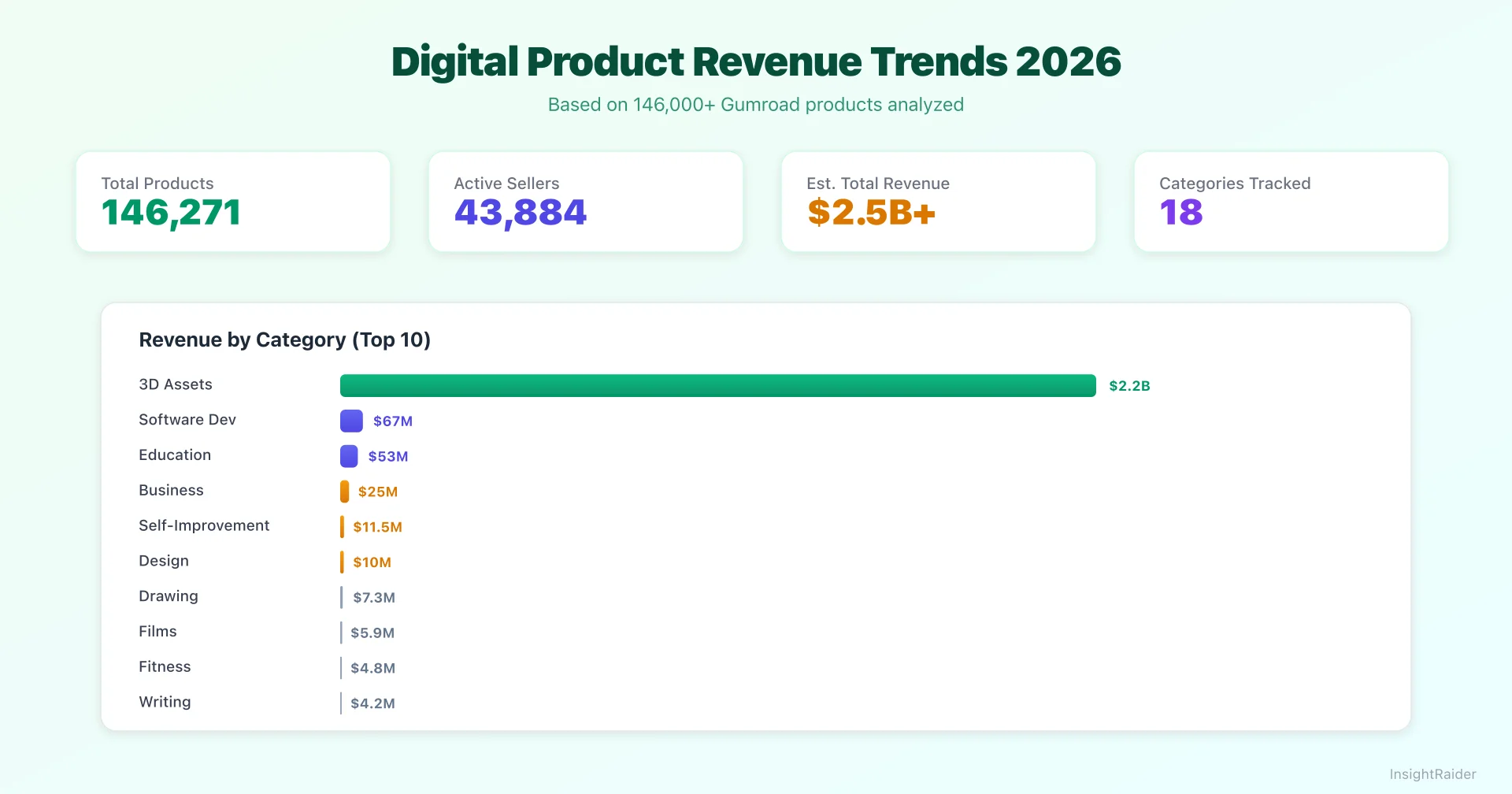
The table below covers all 18 categories in the snapshot: product count, seller count, total estimated revenue, and estimated revenue per product.
| Category | Products | Sellers | Est. Revenue | Est. Revenue / Product |
|---|---|---|---|---|
| Software Development | 8,044 | 2,909 | $67.0M | $8,325 |
| 3D | 9,752 | 3,087 | $18.2M | $1,862 |
| Business & Money | 9,294 | 5,561 | $17.8M | $1,919 |
| Self-Improvement | 9,650 | 4,538 | $10.1M | $1,048 |
| Design | 9,126 | 3,444 | $10.1M | $1,104 |
| Education | 9,701 | 4,121 | $9.7M | $1,004 |
| Other | 10,147 | 4,891 | $9.5M | $938 |
| Drawing & Painting | 9,139 | 2,553 | $7.3M | $798 |
| Fitness & Health | 6,499 | 3,001 | $4.8M | $734 |
| Films | 9,526 | 2,103 | $4.7M | $496 |
| Writing & Publishing | 3,455 | 1,956 | $4.2M | $1,208 |
| Music & Sound Design | 9,417 | 2,492 | $2.7M | $291 |
| Gaming | 8,221 | 1,477 | $2.0M | $239 |
| Photography | 8,593 | 2,035 | $1.9M | $219 |
| Audio | 5,886 | 864 | $1.7M | $281 |
| Comics & Graphic Novels | 3,942 | 1,453 | $529K | $134 |
| Fiction Books | 1,614 | 955 | $76K | $47 |
| Recorded Music | 1,393 | 384 | $41K | $30 |
Total estimated revenue across all categories: $172.2M
The snapshot's collection date and revenue period are not available, so these figures describe relative category size, not monthly earnings or growth. See the estimation methodology for how estimates are built. Our separate State of Gumroad 2026 study covers 146,271 products observed January to April 2026.
Two things jump out immediately. First, Software Development is an outlier: about 39% of all estimated revenue in one category. Second, the bottom of this table is brutal. Fiction Books show $76K across 1,614 products. That's about $47 per product. Let that sink in.
If you want a deeper dive into which niches are actually worth entering, we broke down profitability metrics in our profitable niches guide.
Price Distribution: Median vs. Average Tells the Real Story
On a marketplace where a handful of high-ticket assets sit next to thousands of low-priced downloads, the average price is pulled far above what a typical product costs. The median is the number to watch.
That gap between median and average isn't a rounding error. It's a structural feature of this market. A few premium items (professional 3D assets, specialist software, in-depth courses) drag the average up, while the median tells you what a typical buyer actually pays.
Here's what that means for you. If you're launching at $12, you need volume. Lots of it. If you're launching at $200+, you need positioning and trust. The strategies are completely different, and most advice articles treat them as interchangeable. They aren't. Don't kid yourself.
For a detailed breakdown of what works at each price point, see our pricing strategies guide.
Price Tiers by Category
Categories tend to cluster into three pricing tiers. Check listed prices in your own niche before you place yourself:
Premium tier ($100+): categories such as 3D, specialist education and professional writing resources. These categories support high-ticket products because buyers are either professionals (3D artists buying assets for client work) or serious learners investing in transformation (education courses).
Mid-range tier ($30-99): categories such as Software Development, Business & Money, Self-Improvement, Design and Films. These categories live in the "impulse purchase for professionals" zone. A $50 Notion template or a $64 code boilerplate is an easy yes for someone who bills $100/hour.
Budget tier (under $30): categories such as Music & Sound Design, Photography, Audio, Drawing & Painting, Recorded Music, Comics & Graphic Novels and Fiction Books. Creators here compete on volume and audience size, not margins. It's a grind.
Revenue Concentration: Software Development Leads the Snapshot
This is the single most striking pattern in the snapshot.
Software Development alone accounts for $67.0M out of $172.2M in total estimated revenue, or about 39%. 3D ($18.2M) and Business & Money ($17.8M) follow, far behind.
Why? Three factors converge.
High unit value. Many top products in Software Development and 3D are professional-grade tools and assets: boilerplates, plugins, rigged character models, environment packs, animation libraries. Buyers are developers, studios and freelance 3D artists who treat these as business expenses.
Recurring demand. A game studio or an agency doesn't buy one asset pack or starter kit and stop. Every new project needs new assets and tools. This creates repeat purchase behavior that compounds revenue over time.
B2B economics. When the buyer is a business, price sensitivity drops. For example, a $2,000 asset pack that saves 40 hours of modeling work is an easy decision for a studio billing $150/hour for that labor.
The lesson isn't "go sell software." The lesson is that B2B positioning transforms revenue potential. Wherever the buyer is spending business money, revenue scales differently. You can explore this across niches with InsightRaider's product research.
For context on how this fits into the broader market, see our digital product market size analysis.
Volume vs. Pricing Power: Two Paths to Revenue
There are two fundamentally different strategies for generating revenue, and the category you choose shapes which one you're playing.
The Volume Play: Software Development
Software Development has 8,044 products and $67.0M in estimated revenue in the snapshot, the highest revenue per product of any category ($8,325). This is the Amazon model of digital products: sellers win by creating products that solve specific, repeated problems (starter kits, component libraries, SaaS boilerplates) and selling many copies.
The upside: faster feedback loops, easier to test and iterate. The downside: intense competition, constant pressure to update, and buyers who compare you with free open-source alternatives.
The Pricing Power Play: Education
Education has 9,701 products and $9.7M in estimated revenue ($1,004 per product). The pricing power model sells fewer copies at a higher price. Education products win on authority, transformation promises, and trust.
The upside: higher revenue per customer, stronger brand moats, less price competition. The downside: longer sales cycles, higher customer expectations, and the need for genuine expertise that buyers can verify.
The Hybrid: Business & Money
Business & Money sits in an interesting middle ground: 9,294 products, $17.8M in estimated revenue, and the most sellers of any category (5,561). What it does have is breadth. Everything from cheap spreadsheet templates to premium consulting frameworks lives here.
A common path in this category is to start with a low-ticket product (a free lead magnet or a $19 template) and upsell into higher-ticket offerings. It's the category where funnel thinking matters most.
Platform Insights: Gumroad in Context
Our snapshot covers Gumroad specifically, which gives us a particular lens on the market. Gumroad's strengths and limitations shape what sells there.
What Gumroad does well: Simple product listings, clean checkout, built-in audience discovery, and a simple fee structure (10% + $0.50 per direct sale). It excels for creators who want to ship fast and test product-market fit without building infrastructure.
Where Gumroad has limits: lighter course features than dedicated course platforms, simpler email marketing, and no sales funnel builder. Creators who outgrow Gumroad often move to platforms with more marketing infrastructure.
This may explain part of the pattern in the snapshot. Asset-based categories (Software Development, 3D, Design) rank high, and selling a downloadable file is native to the platform. Selling a 12-week fitness transformation program isn't.
For creators evaluating where to sell, the platform choice matters as much as the product choice. We compared two common options in our Gumroad vs Systeme.io breakdown. The short version: Gumroad is better for digital assets and simple products, Systeme.io is better for courses and funnel-driven businesses.
Free Products: The Lead Magnet Economy
Free products are a normal part of the Gumroad catalog. They aren't necessarily failed products. Many are deliberate lead magnets designed to capture email addresses and funnel buyers toward paid offerings.
Free lead magnets tend to matter most where trust-building matters most: Education, Self-Improvement, and Business & Money. In asset-heavy categories such as 3D, Design, and Software Development, the product value is easier to judge from previews and demos.
Three Actionable Takeaways from the Data
Based on the category snapshot, three strategic moves stand out. They are inferences from modeled estimates, not guarantees, but the pattern is hard to ignore.
1. Follow the B2B Money
The revenue concentration in Software Development ($67.0M) and 3D ($18.2M) isn't an accident. It's what happens when your buyers are businesses with budgets rather than individuals with credit cards. You don't need to sell software or 3D assets to apply this principle.
Any category becomes more lucrative when you position for business buyers. For example, a "Notion template for freelancers" might sell for $19, while a "Client Onboarding System for Agencies" can justify $149. Same underlying product, different buyer, different price.
Look at your niche through a B2B lens. Who would pay 5x more because this saves their business time or money?
2. Avoid the Volume Trap Below $15
Many digital products are priced in a range that requires enormous volume to generate meaningful revenue. Fiction Books ($76K estimated across 1,614 products) is the cautionary tale: about $47 per product. That's not a business. That's a rounding error.
If your product naturally lives below $15, you need either strong organic traffic or a clear upsell path to higher-ticket products. A $12 ebook that feeds into a $200 course is a strategy. A $12 ebook as your entire business model is a struggle.
In lower-priced categories such as Drawing & Painting or Music & Sound Design, a catalog matters more than a single product. One product at $21 is a hobby. Fifty products at $21 with an engaged audience is a business.
3. Pick Your Game Before You Pick Your Niche
There are two games: volume and pricing power. Software Development ($67.0M) and Education ($9.7M) both carry meaningful estimated revenue in the snapshot, but they reward different mechanisms.
Before you choose a niche, decide which game suits your strengths. If you're a prolific builder who ships fast, the volume game in Software Development, Design, or Business & Money rewards speed and iteration. If you're a deep expert who builds authority, the pricing power game in Education, Writing & Publishing, or specialized 3D rewards depth and positioning.
Playing the wrong game in the right niche still loses. Playing the right game in a decent niche gives you a real chance.
For a step-by-step process to identify which niche fits your profile, follow the framework in our guide on how to find a profitable niche.
Frequently Asked Questions
What are the fastest growing digital product categories in 2026?
The category snapshot cannot measure growth, because its collection date and revenue period are not available. What it shows is where estimated revenue concentrates: Software Development ($67.0M), 3D ($18.2M) and Business & Money ($17.8M) lead in InsightRaider modeled estimates. Self-Improvement and Design (about $10.1M each) also show healthy activity. To judge growth, compare dated observations of the same products over time rather than a single snapshot.
How much revenue do digital products generate on Gumroad?
InsightRaider's category snapshot estimates $172.2M in total revenue across 133,399 Gumroad products in 18 categories. Our separate State of Gumroad 2026 study estimates $206M across 146,271 products observed January to April 2026. Both are modeled estimates, not Gumroad-reported sales. Revenue is heavily concentrated: Software Development alone accounts for about 39% of the snapshot total.
What is the average price of a digital product in 2026?
It depends heavily on the category, and averages are skewed by premium professional assets, so the median price in your own niche is a more useful benchmark. In the State of Gumroad 2026 dataset, Software Development products average $39.95, Self-Improvement products $26.67, and courses $95.74. Check listed prices of comparable products before you set yours.
Why do 3D and software products lead digital product revenue?
Three factors explain it. First, many top products are professional-grade assets and tools bought by studios and developers, not hobbyists. Second, demand is recurring, since every new game, film, software or XR project needs new assets and tools. Third, B2B economics reduce price sensitivity: for example, a $2,000 character model that saves 40+ hours of manual work is a clear ROI purchase for a studio. This pattern, where B2B positioning transforms revenue potential, applies to any category where you can reframe the buyer from "individual consumer" to "professional with a budget."
Which digital product niches should beginners avoid?
Beginners should be careful with categories that show low total revenue and low revenue per product. In the snapshot, Fiction Books ($76K across 1,614 products) and Recorded Music ($41K across 1,393 products) are the weakest, and Comics & Graphic Novels ($529K across 3,942 products) is similarly challenging. These categories require either massive audience scale or a clear upsell strategy to higher-ticket products. Beginners are often better served in categories like Business & Money ($1,919 per product), Software Development, or Design ($1,104 per product), where each sale is more likely to justify the work.
How does Gumroad compare to other platforms for selling digital products?
Gumroad excels at selling downloadable digital assets thanks to its simple listing process, clean checkout, and 10% + $0.50 fee on direct sales. In the snapshot, its top categories by estimated revenue include Software Development and 3D. However, Gumroad offers lighter course features, simpler email marketing and no sales funnel builder. Creators selling courses, membership programs, or transformation-based products often find better infrastructure on platforms like Systeme.io. The short answer: pick Gumroad for simple digital products and assets, pick a funnel-oriented platform for courses and high-ticket offers.
Got more questions? Check out our data-driven answers: