Here is a hypothetical scenario (an illustration, not a real case). A creator named Alex spends four months building a watercolor painting course. Beautiful content. Professional videos. Total revenue after six months: $340.
Meanwhile, his friend picks "Notion templates for real estate agents", a niche Alex had never considered, and reaches $8K/month within 90 days.
In this scenario, the difference isn't talent or marketing. It's the niche decision they made before writing a single word. That's it. One decision. $340 versus $8K/month.
Plenty of creators fail because they skip the research, not because the market is bad. This guide gives you the exact framework: repeatable, testable, and easy to check against modeled revenue estimates for 500K+ products on Gumroad, Whop and Skool.
Why Most Creators Choose the Wrong Niche
Two traps catch almost everyone.
The Passion Trap
"Follow your passion" is the most expensive advice in the creator economy. Not because it's entirely wrong (you do need genuine interest in your niche), but because it ignores a critical variable: whether anyone will pay for what you're passionate about.
A creator who loves watercolor painting might spend 6 months building a $49 course on "Watercolor Basics for Beginners." But if, say, the total addressable market on Gumroad for watercolor courses were only $3k/month, the ceiling would be brutal. Meanwhile, a creator who's moderately interested in Notion templates for project managers could be entering a much larger market. For a snapshot of where modeled revenue concentrates, see our breakdown of the most profitable niches in 2026.
Passion matters. But passion without market demand is an expensive hobby. Don't confuse the two.
Saturation Blindness
The opposite trap is equally dangerous. Some creators look at a busy market and think, "Too competitive, I need to find something nobody's doing." So they pick an obscure niche with zero competition, and zero demand.
The counterintuitive truth: competition is a demand signal. If 30 creators are selling productivity templates, it usually means people are buying productivity templates. Your job isn't to avoid competition; it's to find the angle where competition is weak but demand is strong.
The strongest sellers rarely invent new categories. They find underserved segments within proven markets. That's how this works.
The 4-Step Niche Research Framework
This is the system we use when we review comparable offers across Gumroad, Whop and Skool. It adapts to most product types and markets.
Step 1: Read the Demand Signals
Before you commit to a niche, you need evidence that people are actively looking for solutions in that space. Not feelings. Evidence.
Google Trends
Search your niche keywords and look for:
- Sustained interest: A keyword that holds steady or grows over 12 months is far better than one that spiked once and died.
- Seasonal patterns: Some niches (tax prep, New Year's resolutions) are cyclical. Not disqualifying, but you need to plan around it.
- Related queries: These often reveal sub-niches you hadn't considered. "Notion template" might show rising interest in "Notion template for real estate": that's a specificity signal.
Reddit is the most underused niche research tool on the internet.
- Search your niche keywords across subreddits
- Filter by "Top - Past Year" to find the most engaged posts
- Look for recurring themes: "How do I...", "Looking for...", "I wish there was..."
- Count the frequency of these pain-point posts: more posts = more demand
Pro tip: Pay special attention to posts where someone asks for a recommendation and gets mediocre answers. That gap between what people want and what currently exists is where money lives.
Marketplace Browsing
Go directly to where digital products are sold:
- Gumroad: Browse categories, sort by popularity, note what's selling
- Whop: Check trending communities and products
- Etsy (for templates): Sort by bestselling in relevant categories
- Udemy/Skillshare (for courses): Look at enrollment numbers and review counts
What you're looking for: multiple products in a niche that clearly have traction. If you can find 5-10 products that appear to be selling consistently, you've got a viable market.
Step 2: Map the Competition
Demand without competition analysis is half the picture. You need to understand who's already serving this market and where the gaps are.
Build a competitor grid (our competitor analysis framework for digital products walks through this in full detail):
For each niche you're considering, identify the top 10-15 products and document:
- Product name and creator
- Price point (note the range: is there a clear pricing cluster?)
- Estimated revenue (use review counts, social proof signals, or InsightRaider for modeled estimates)
- Product format (PDF, video course, template, community)
- Unique angle (what specific promise are they making?)
- Weaknesses (what are buyers complaining about in reviews?)
What to look for in this grid:
- Pricing gaps: If everyone charges $19-29, there might be room for a premium $79-149 product with more depth. Or vice versa: if everything is $199+, a solid $39 product could clean up on volume.
- Format gaps: If every competitor sells a static PDF, a video course with templates might stand out. If everyone has a course, a done-for-you template pack might win.
- Audience gaps: If every product targets beginners, there's often an underserved intermediate or advanced audience willing to pay more.
- Quality gaps: If the top products look like they were made in 2019, modern design and UX alone can be a competitive advantage.
Step 3: Estimate Revenue Potential
This is where most creators either give up or start guessing. But revenue estimation is critical: it tells you whether a niche can support the income level you're targeting.
The manual method:
For products on Gumroad or similar platforms:
- Count reviews: Pick a review rate to work with, for example 2-5% of buyers (an assumption, not a measured Gumroad rate). At that rate, a product with 50 reviews would have 1,000-2,500 sales total.
- Estimate monthly sales: If the product has been live for 12 months, divide total estimated sales by 12.
- Calculate revenue: Monthly sales x price = estimated monthly revenue.
Example calculation:
- Product price: $39
- Total reviews: 85 (product launched ~18 months ago)
- Estimated total sales, assuming a 3% review rate: 85 / 0.03 = ~2,833
- Estimated monthly sales: 2,833 / 18 = ~157
- Estimated monthly revenue: 157 x $39 = ~$6,100/month
This isn't perfect, and the result moves a lot with the review rate you assume, but it gives you a ballpark. And a ballpark is infinitely better than a guess. For a full picture of how large the opportunity is, see our digital product market size breakdown.
What revenue level makes a niche viable? Use these as rules of thumb, not measured thresholds:
- If the top 3 products in a niche each make $5k+/month, the niche is proven and healthy.
- If the top product makes $2-5k/month, the niche is viable but you'll need strong positioning.
- If no product breaks $1k/month, you're either looking at the wrong niche or you've found a micro-niche that can only support a side income.
Your target matters too. If you want to build a $20k/month business, you need a niche where that ceiling exists. If you want a $3k/month side income, your options are much broader. Be honest with yourself about what you're after.
Step 4: Assess Personal Fit
After demand, competition, and revenue checks pass, the final filter is you. And yes, this is where passion comes back in, but as a filter, not a starting point.
Ask yourself:
- Can I credibly teach or build in this space? You don't need to be a world expert, but you need enough knowledge to create something genuinely useful.
- Can I sustain interest for 12+ months? Building a digital product business isn't a weekend project. You'll need to create content, engage with customers, and iterate.
- Do I have an unfair advantage? Maybe you have an audience in this space, professional experience, a unique methodology, or access to proprietary data.
- Am I excited enough to go deep? The best products come from creators who obsess over their niche's problems. Surface-level interest produces surface-level products.
The sweet spot: A niche where demand is proven, competition has gaps, revenue potential meets your goals, and you have enough genuine interest and credibility to build something great.
How to Score and Rank Your Niche Ideas
If you're evaluating multiple niches (and you should be: always evaluate at least 3-5), you need a systematic way to compare them.
Rate each niche 1-5 on these criteria:
| Criteria | What to Evaluate | Weight |
|---|---|---|
| Demand Strength | Search volume, Reddit activity, marketplace presence | x3 |
| Revenue Ceiling | Top product revenue, market size, price tolerance | x3 |
| Competition Gap | Quality gaps, audience gaps, positioning opportunities | x2 |
| Personal Fit | Credibility, interest, unfair advantages | x2 |
| Ease of Entry | Time to first product, required investment, complexity | x1 |
Calculate your weighted score for each niche. The math is simple: (rating x weight) summed across all criteria. Maximum possible score: 55.
Scoring guide:
- 40-55: Strong niche. Move to validation immediately.
- 30-39: Promising niche. Dig deeper on the weak areas before committing.
- 20-29: Risky niche. Likely has a dealbreaker hiding in the weak scores.
- Below 20: Move on. This niche isn't worth your time.
Critical rule: Never let a single criterion carry the entire score. A niche that scores 5/5 on personal fit but 1/5 on demand and revenue is a passion project, not a business. A niche with 5/5 demand but 1/5 personal fit will burn you out before you see returns.
Red Flags That a Niche Won't Work
Even a niche that looks good on paper can have hidden problems. Watch for these.
1. One dominant player owns the market
If a single creator or brand controls 70%+ of a niche's revenue, breaking in is extremely difficult. They have the audience, the SEO, and the social proof. You'd need a dramatically different angle or product format to compete.
2. Prices are in a death spiral
When you see a niche where prices have dropped year over year ($49 products becoming $29 becoming $9), that's commoditization. The market is telling you that buyers see these products as interchangeable. Unless you can create genuinely differentiated value, avoid it.
3. The audience doesn't spend money online
Some audiences are active online but culturally resistant to buying digital products. This is common in certain hobbyist communities where free content is the norm. If Reddit threads about your niche are full of "why would I pay for this when YouTube is free," you'll face an uphill battle on conversions.
4. The niche is shrinking
Google Trends showing a clear downward trajectory over 2-3 years is a serious warning. You can still make money in a declining niche, but you're swimming against the current.
5. Your product idea solves a "nice-to-have" problem
The most profitable digital products solve urgent, painful problems. "How to organize your Notion workspace" is nice-to-have. "How to land your first 5 freelance clients in 30 days" is urgent and painful. Urgency drives purchases. (No, your course idea isn't unique. But it doesn't need to be. It needs to solve a painful problem.)
6. You can't name 3 specific people who'd buy it
If you can't immediately think of real people (friends, colleagues, online acquaintances) who would genuinely benefit from your product, your understanding of the audience is too abstract. The best niche products are built for a person you can visualize clearly.
How InsightRaider Automates Niche Discovery
Everything in this framework works. But the honest truth: doing it manually can take days per niche. Counting reviews. Estimating revenue. Building competitor grids. Cross-referencing trends. It's tedious, and the estimates are rough.
That's why we built InsightRaider.
What InsightRaider speeds up:
- Compare relevant offers: Review public product signals on Gumroad, Whop and Skool, then verify the original listing. Check the dates and coverage available; modeled revenue is not verified monthly earnings.
- Trend analysis: Dated observations for products and categories where coverage allows, so you can judge whether a niche looks to be growing, stable, or declining.
- Competition mapping: Competitor views with prices, formats and modeled revenue estimates, so you can spot gaps with less manual research.
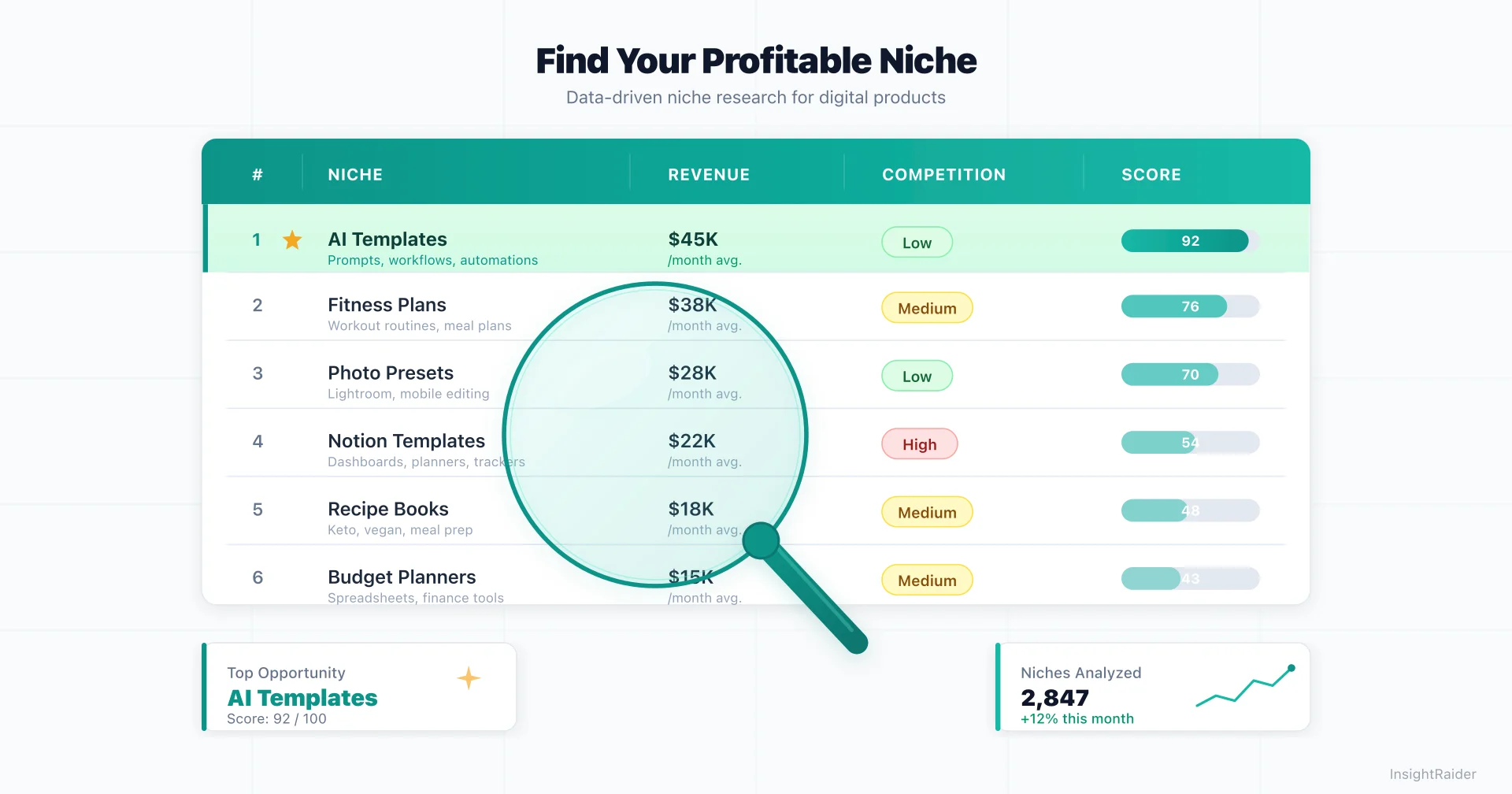
- Niche scoring: Our model weighs demand strength, revenue potential, and competition dynamics (the same criteria as the scorecard above) into a niche score you can check against the listings.
The result: Less time in spreadsheets, more time on the niches worth testing.
More importantly, you're working with transparent revenue estimates instead of an unsupported hunch. If, for example, comparable products in "AI prompts for marketers" showed an estimated $87k/month collectively, treat that as a directional market signal, not proof of demand for a new idea. Compare the evidence around your existing offer, then test it with buyers.
Your Action Plan
You now have everything you need to find a profitable niche. No more excuses.
- Brainstorm 5-10 niche ideas based on your skills, interests, and observations about what people struggle with
- Run each through the 4-step framework: demand signals, competition mapping, revenue potential, personal fit
- Score them on the niche scorecard and rank them by weighted total
- Eliminate any with red flags no matter how exciting they seem
- Pick your top 1-2 and validate your niche without building a product first using our framework, then confirm with the 48-hour validation framework
The creators who win in 2026 aren't the ones with the best ideas. They're the ones who pick the right niche, validate it with data, and then execute relentlessly. The niche decision is the foundation everything else is built on.
Don't rush it. Don't guess. Let the data lead. And then move fast.
The 4-step framework in this guide works by hand, but it takes time. InsightRaider brings demand signals, modeled revenue estimates and competition gaps for Gumroad, Whop and Skool products into one place. See how it works.