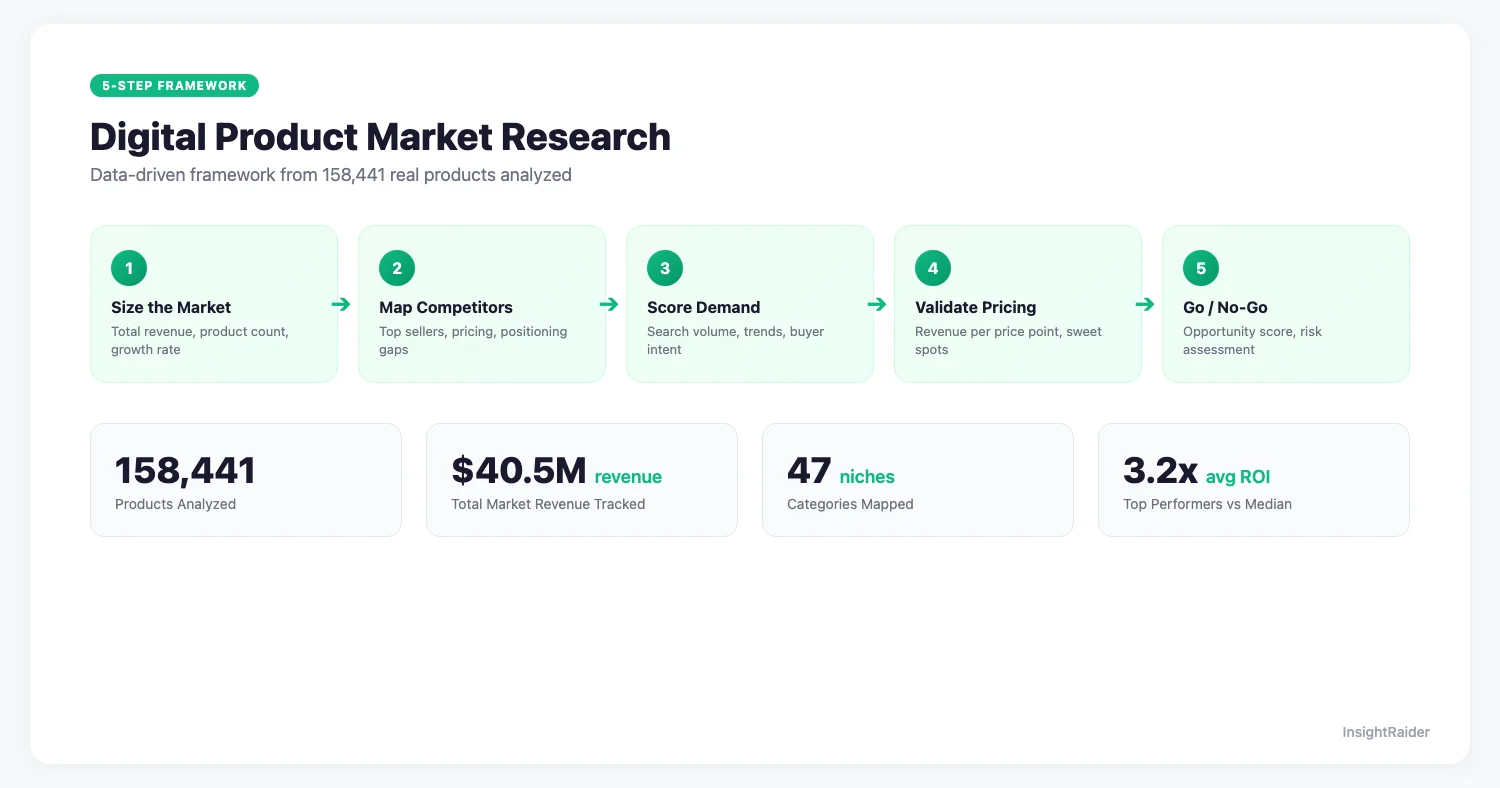
Digital Product Market Research: A Data-Driven Framework (158K Products Analyzed)
A Notion template creator posted on Reddit last month: "I spent 3 months building the ultimate habit tracker. Got 2 sales. What went wrong?"
The top reply, with 847 upvotes: "Did you check if anyone was looking for a habit tracker before you built one?"
He hadn't. And he's not alone. We analyzed 158,441 digital products across 28,000+ creators on Gumroad -- totaling $40.5M in estimated revenue -- and found that 65,258 products (44.6%) earned exactly $0. Nearly half of everything ever launched made nothing.
The market isn't broken. But most people never investigate it before jumping in.
This guide is about the investigation -- the specific steps, tools, and scoring methods that separate informed launches from expensive guesses. If you're still deciding which niche to pick, start with our niche selection framework. This article assumes you have a niche in mind and need to figure out if the numbers work.
Step 1: Size the Market (TAM/SAM/SOM)
Before anything else, answer: how big is this opportunity?
Most creators never do this because "market sizing" sounds like an MBA exercise. It's not. It's three numbers that take 20 minutes to estimate and save you months of building for a market that can't support your goals.
TAM (Total Addressable Market): The total revenue generated by all products in your broad category across all platforms.
SAM (Serviceable Addressable Market): The revenue in your specific sub-niche on the platforms you'll sell on.
SOM (Serviceable Obtainable Market): What you can realistically capture in 12 months based on competition and your positioning.
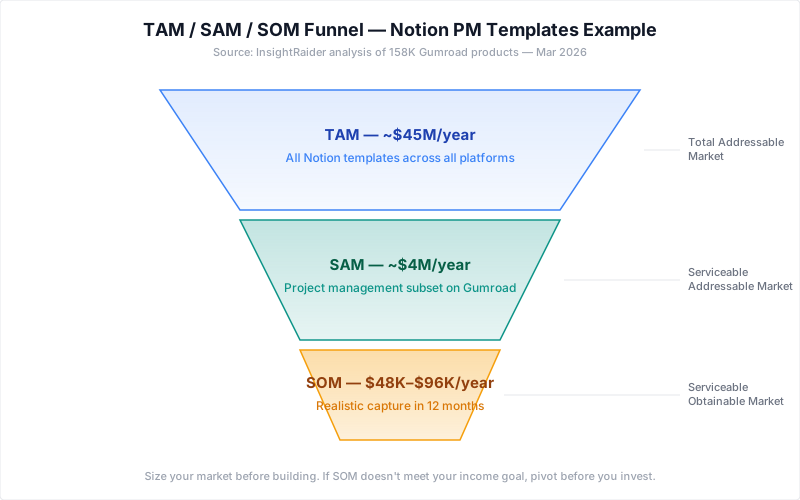
Worked example -- Notion templates for project managers:
| Level | Estimate | How We Got It |
|---|---|---|
| TAM | ~$45M/year | Total Notion template revenue across Gumroad, Etsy, own sites (Gumroad alone: $8.2M in our dataset) |
| SAM | ~$4M/year | Project management subset on Gumroad (~18% of Notion template revenue based on product counts) |
| SOM | $48K-$96K/year | Top 10% of PM template sellers average $4K-$8K/month in our data |
That SOM number tells you the ceiling. If $48K-$96K/year meets your income goal, the niche is worth investigating further. If you need $300K/year from this niche alone, the math doesn't work -- and you know that before building anything.
Where to get the numbers:
- Our dataset gives you Gumroad-specific revenue by category and sub-niche
- Google Trends confirms whether the market is growing, flat, or declining
- Marketplace browsing (Etsy, Whop, Teachable) adds the multi-platform dimension
- Industry reports from Statista or Grand View Research provide the broadest TAM estimates (often free summaries)
For the full picture of how revenue distributes across all 18 Gumroad categories, see our digital product market size analysis.
Step 2: Read Demand Signals
Market size tells you the ceiling. Demand signals tell you whether buyers are actively looking for solutions right now.
Not "could people want this?" Not "my friends said they'd buy it." Measurable signals.
Where to find them and what to trust:
| Signal Source | What to Look For | Reliability |
|---|---|---|
| Google Trends | Sustained or growing interest over 12+ months | High |
| Reddit/forums | Repeated questions asking for solutions ("looking for," "I wish there was") | High |
| Gumroad ratings | Products in your niche with 100+ ratings | Very High |
| Keyword tools (Ahrefs, Ubersuggest) | Search volume for "[your niche] + template/course/tool" | High |
| Social media | Creator posts about the topic getting engagement | Medium |
The signal that matters most in our dataset: Products with 2-3 professional cover images generated 15x more revenue than products with zero covers. That's not a demand signal by itself -- it's a response to demand. Creators who invest in presentation have already validated that buyers are looking.
Red flag: If you can't find at least 3 independent demand signals, the market may be too small or too early. That's not a death sentence, but it means higher risk.
Step 3: Map the Pricing Landscape
This is where most creators make their costliest mistake.
Our data across 158K products is blunt: $100+ products dominate revenue in 17 out of 18 categories. The "race to the bottom" at $9.99 is a death sentence for revenue.
What the pricing data shows:
| Strategy | Revenue Impact |
|---|---|
| Pay What You Want (PWYW) | 2.8x more revenue than fixed-price equivalents |
| 2-3 pricing tiers | 2x revenue versus single-tier products |
| $100+ price point | Dominates average revenue in almost every category |
| Stated refund policy | Significantly higher revenue (trust signal) |
How to use this in your research: Pull up the top 20 products in your target niche. Map their prices on a simple chart. You'll see clusters -- most products bunch around 2-3 price points. The gap between clusters is your opportunity.
If everyone charges $19-$29, there's room for a premium $99 product with more depth. If everything is $199+, a sharp $49 product could win on volume. The goal isn't to match competitors -- it's to find the price point nobody serves well.
For the full pricing playbook, see our digital product pricing strategies guide.
Step 4: Build a Competitor Grid
Now you have market size, demand signals, and pricing intel. Time to map the actual players.
For every competitor product, track these 5 data points:
- Price point and tier structure -- single price, tiered, PWYW?
- Ratings count -- proxy for sales volume (2-5% of buyers rate on Gumroad)
- Description length -- products with 5,000+ character descriptions earned 20x more revenue than those under 500 characters
- Cover images -- 2-3 covers correlates with 15x revenue
- Rating distribution -- products with 70-89% five-star ratings averaged $170K revenue vs. $22K for 90-100% five-star (more sales = more variance)
What to look for in the grid:
You're not searching for the strongest competitor. You're searching for the gap -- the price point nobody serves, the angle nobody takes, the audience segment nobody targets.
Real gap from our data: In education, 300 products use subscription pricing -- the highest ratio of any category. But most subscription courses are priced under $20/month. The gap: premium subscription courses ($50+/month) with ongoing content updates. Demand exists (subscription works in education), the price point works ($100+ dominates), but few creators combine the two.
Our competitor analysis guide walks through building the full grid step by step. If you're researching the education niche specifically, see our most profitable online courses breakdown for revenue data across 9,987 course products.
Step 5: Validate Before You Build
Market size checks out. Demand signals are there. Pricing landscape is mapped. Competitors have gaps. One step left: confirm that real people will pay before you build the full product.
This is the step most creators skip -- and it's the cheapest insurance against a $0 launch.
Three validation methods, ranked by reliability:
Method 1: The Landing Page Test
Build a single landing page describing your product. Drive 200-500 visitors from your target audience (Reddit posts, social media, small ad spend). Measure opt-ins or pre-orders.
- Above 10% opt-in rate: Strong signal. Build the product.
- 5-10% opt-in rate: Moderate signal. Refine the positioning, test again.
- Under 5%: Weak signal. Rethink the offer or the audience.
Method 2: The Reddit Thread Test
Post in relevant subreddits asking about the specific problem your product solves. Don't pitch -- ask. "I'm working on X for people who struggle with Y. Has anyone tried solving this? What worked and what didn't?"
If 20+ people engage with specific pain points that match your product concept, you've got validation. If the thread gets 2 comments and dies, reconsider.
Method 3: The Pre-Sale Test
List your product on Gumroad with a "coming soon" page or a reduced pre-sale price. If 10+ people pre-order with zero marketing budget, the demand is real.
For the complete validation playbook, see our niche validation framework.
Scoring Your Research: The Go/No-Go Checklist
After running all 5 steps, score your findings:
| Criteria | Green Light | Yellow Light | Red Light |
|---|---|---|---|
| Market size (SOM) | Meets your income goal | Within 50% of goal | Less than 50% of goal |
| Demand signals | 3+ independent signals | 1-2 signals | No signals found |
| Pricing opportunity | Clear gap in the market | Crowded but room for differentiation | Race-to-the-bottom pricing |
| Competitor gaps | Obvious unserved angle | Minor gaps to exploit | Dominant player owns 70%+ |
| Validation response | 10%+ opt-in or 10+ pre-sales | 5-10% opt-in | Under 5% opt-in |
3+ green lights: Launch. The data supports it.
Mixed green/yellow: Proceed with caution. Double down on the weak areas before committing serious time.
Any red lights: Investigate further or pivot. Red lights don't always mean "no" -- but they mean "not yet" or "not this way."
Tools for the Research Process
You can do everything above manually. But it takes 20-40 hours per niche.
Free tools:
- Google Trends -- demand signals and seasonality
- Reddit search -- qualitative demand signals and pain points
- Gumroad browse -- competitor mapping (manual and slow)
Paid tools:
- InsightRaider -- revenue estimates, niche scoring, and competitor grids for 158K+ products across Gumroad. Turns 20 hours of manual research into 2 minutes.
- SEMrush/Ahrefs -- keyword research and search volume data
- SparkToro -- audience research and interest mapping
The best research combines quantitative data (revenue estimates, pricing analysis, market sizing) with qualitative signals (Reddit threads, customer conversations, landing page tests). Tools give you the quantitative side. Your judgment fills in the rest.
This framework works -- but doing it manually is brutal. InsightRaider gives you revenue estimates, competitor grids, and niche scores for 158K+ products in minutes. Stop guessing. Start with data.