Most Profitable Online Courses in 2026: Real Revenue Data From 9,987 Products
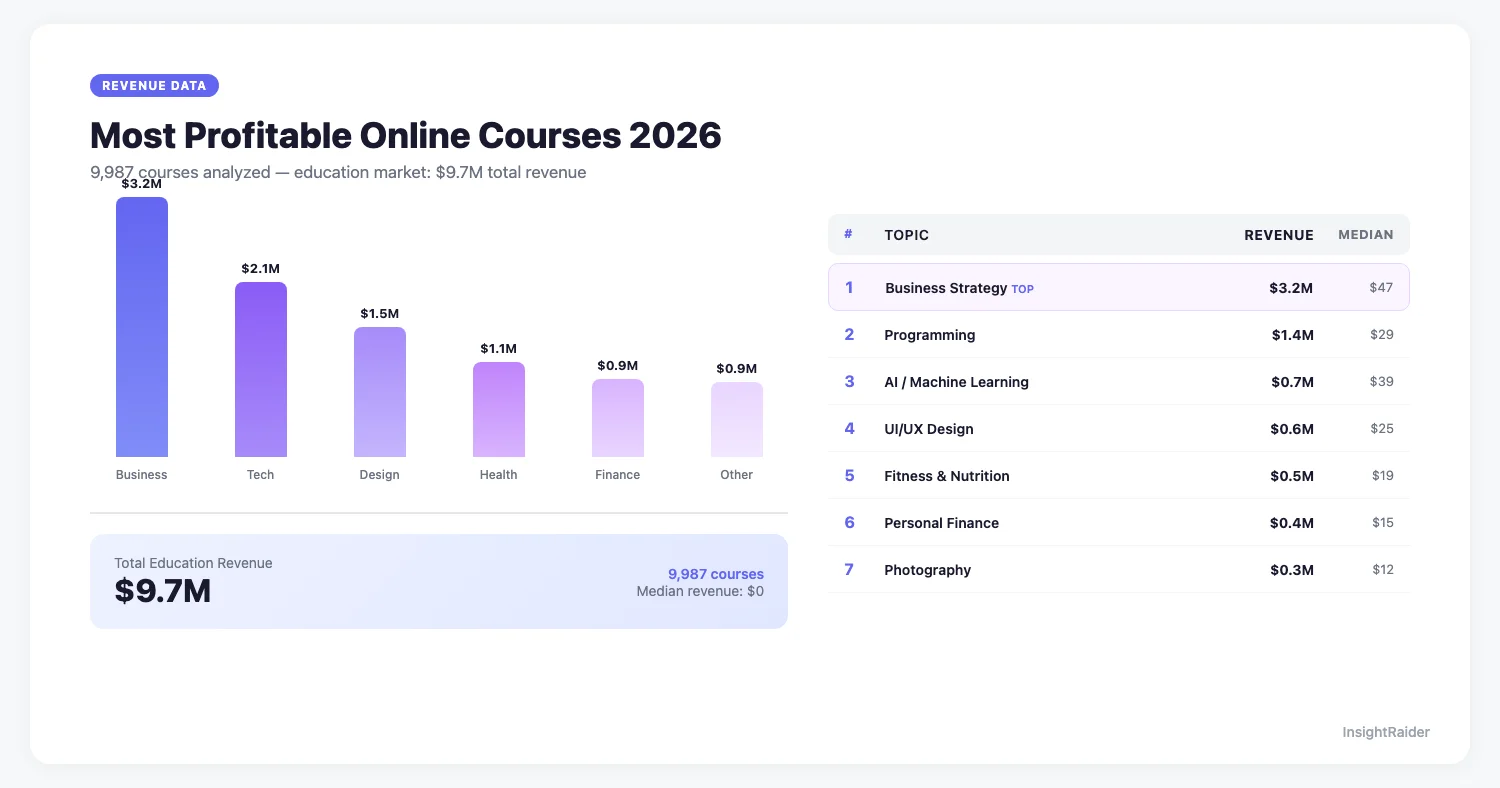
Education is a $9.7 million market on Gumroad alone. That sounds promising -- until you dig in.
We analyzed every course product in the Gumroad ecosystem: 9,987 products, 4,184 sellers, and $9.7M in total estimated revenue. The average price is $62.47. The median price is $19. And the median course earns $0.
But that's not a reason to avoid courses. It's a reason to study what separates the ones that earn $5K+ from the ones that earn nothing.
The State of Online Courses: Raw Numbers
| Metric | Value |
|---|---|
| Total products | 9,987 |
| Total sellers | 4,184 |
| Total estimated revenue | $9.7M |
| Average price | $62.47 |
| Median price | $19 |
| Average revenue per product | $974 |
| Average revenue per seller | $2,326 |
| Subscription products | 300 (highest of any category) |
Two numbers jump out. First: $2,326 average revenue per seller. If you can beat the average, you're already in the top half. Second: 300 subscription products -- the highest count of any Gumroad category. Education has a natural fit with recurring revenue. More on that later.
The average price of $62.47 versus the median of $19 tells you the distribution is skewed hard right. A few high-priced courses pull the average up. Most courses are priced too low to generate meaningful revenue.
The Most Profitable Course Niches
Not all course topics are equal. When we break education down by sub-niche, the revenue gaps are wide.
Software Development Courses
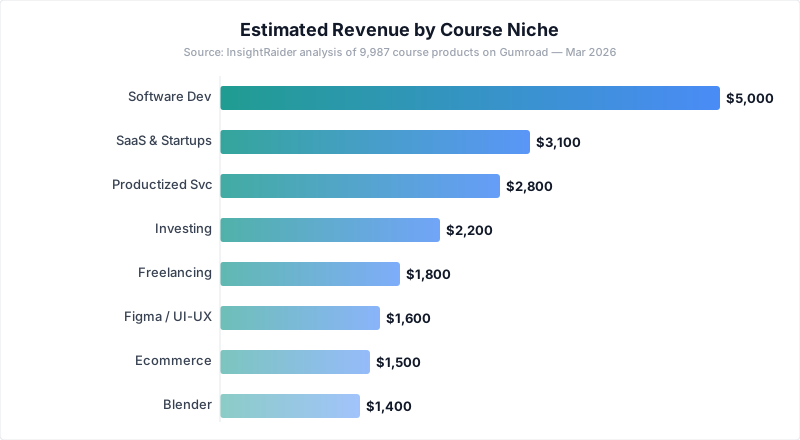
The clear winner. Software dev courses at the $100+ price point average roughly $5,000 in revenue per product. The audience is large, willing to pay premium prices, and actively searching for skill upgrades.
What sells: Full-stack web development, specific framework deep dives (React, Python, DevOps), and career-switching bootcamp-style courses. The key is specificity. "Learn to Code" earns nothing. "Build a SaaS with Next.js and Stripe" earns thousands.
Real example: Courses focused on specific stacks -- like a "Full-Stack React + Node.js" deep dive -- consistently appear in the top revenue percentiles of our dataset. The pattern: narrow the technology, widen the audience by promising a concrete outcome.
Business & Money Courses
The second-largest revenue pool, with $2.8M in estimated total revenue across 2,100+ products. Average revenue per product sits around $1,300 -- but that average hides a brutal split. The top 10% of business courses pull in $5K-$15K each, while the bottom 80% earn under $200.
What sells: Courses with concrete financial outcomes. "How to Land Your First 3 Freelance Clients" outperforms "Introduction to Freelancing" every time. The more specific the dollar outcome in the title, the higher the revenue.
The sub-niche breakdown that matters:
| Business Sub-Niche | Avg Revenue/Product | Competition Level |
|---|---|---|
| Freelancing & client acquisition | ~$1,800* | High (many generic courses) |
| Ecommerce & dropshipping | ~$1,500* | Very high |
| Investing & trading | ~$2,200* | High, but premium pricing works |
| SaaS & micro-startups | ~$3,100* | Lower -- growing fast |
| Productized services | ~$2,800* | Low -- underserved |
Estimated revenue based on extrapolations from our Gumroad dataset of 158K products.
The highest-revenue business courses share a pattern: they promise a specific income outcome in a specific timeframe for a specific audience. "How to build a $5K/month freelance copywriting business in 90 days" beats "Freelancing 101" by a factor of 10x or more.
Creative Skills Courses
Design, illustration, 3D modeling, and music production. Total revenue pool: ~$1.9M across 1,800+ products. Revenue per product is lower than software or business ($1,050 average), but the audience is loyal and buys multiple products over time.
What sells: Tool-specific mastery outperforms general creative theory every time. The most profitable niches data confirms this: Blender content (demand density: 46) and ZBrush resources (demand density: 46) have the highest demand density of any niche on the platform.
The sub-niche breakdown:
| Creative Sub-Niche | Avg Revenue/Product | Demand Density |
|---|---|---|
| Blender tutorials & workflows | ~$1,400* | 46 (highest) |
| Procreate technique courses | ~$900* | 42 |
| Figma & UI/UX design | ~$1,600* | 13 (but higher price tolerance) |
| Music production (Ableton, FL Studio) | ~$800* | 11 |
| Photography & Lightroom | ~$700* | 8 |
Estimated revenue based on extrapolations from our Gumroad dataset of 158K products.
Real example: Creators like Jingsketch (Procreate) have built entire careers on the Gumroad ecosystem. Jingsketch has 11 products averaging 1,537 ratings each -- all brush packs and tutorials in a single niche. The strategy: go deep in one tool, build a catalog, let the ratings compound.
The Pricing Sweet Spot
This is the single most important finding for course creators.
$100+ courses average $5,000 in revenue. Courses priced under $20 average a fraction of that.
And this isn't just because expensive courses attract better marketers. The price itself is a signal. A $19 course says "this is a side project." A $149 course says "this is a serious investment in your skills." Buyers treat them accordingly.
The pricing data across all 158K products in our dataset confirms this at scale: $100+ products dominate revenue in 17 out of 18 categories. Education is no exception. For the full pricing analysis, see our digital product pricing strategies breakdown.
How to Price Your Course
| Price Range | What It Signals | Best For |
|---|---|---|
| Under $20 | "Quick resource" | Lead magnets, mini-courses, list builders |
| $20-$49 | "Solid content" | Single-topic tutorials, workshops |
| $50-$99 | "Comprehensive" | Multi-module courses with exercises |
| $100-$199 | "Professional" | Full curriculum, certification-style |
| $200+ | "Premium transformation" | Cohort-based, mentorship, career outcomes |
The sweet spot for solo creators is $97-$149. High enough to signal quality. Low enough to be an impulse buy for professionals investing in their careers. And the data backs it: this range hits the balance between volume and revenue per sale.
Three Tactics That Move the Revenue Needle
The patterns from our full 158K product analysis apply doubly to courses. Three stand out as especially relevant for education:
Tactic 1: Tiered Pricing
Offer 2-3 tiers -- course-only, course + templates + community, and a premium tier with 1-on-1 access. For courses, the top tier often generates 30-40% of total revenue from fewer than 10% of buyers. Don't leave that money on the table.
Tactic 2: Your Description Is Your Sales Page
Your Gumroad listing needs to do the selling: module breakdowns, learning outcomes, who it's for, who it's not for, and concrete results students can expect. A 200-word description is a flyer on a bulletin board. A detailed listing is a one-on-one conversation with the buyer.
Tactic 3: PWYW as a Funnel (Not a Pricing Strategy)
Offer a mini-course or intro module as Pay What You Want to build your email list and Gumroad ratings. Then sell your premium course at a fixed $99-$199 to the audience you've built. Sellers who mix free and paid products see the best paid-product performance in our data.
The Subscription Opportunity
Here's a statistic that should grab your attention: education has 300 subscription products -- the highest count of any Gumroad category.
And it makes perfect sense. Courses have natural subscription models:
- Monthly content drops: New lessons, updated materials, fresh case studies
- Community access: Ongoing forums, live Q&As, peer groups
- Tool updates: For software-related courses, keeping content current is inherently recurring
- Coaching layers: Monthly group coaching calls on top of self-paced content
Subscription courses solve the creator's biggest problem: the revenue rollercoaster. Instead of launching, spiking, and crashing, you build predictable monthly recurring revenue.
The gap: Most subscription courses are priced under $20/month. Given that $100+ pricing dominates in education, there's room for premium subscriptions at $49-99/month with genuinely valuable ongoing content.
How to Choose Your Course Topic
Forget what you "want" to teach. Start with what the market wants to learn.
Step 1: Pick a proven category. Software development, business skills, and creative tools are the three strongest. Don't invent a new category unless you have an audience already waiting for it.
Step 2: Go specific. "Learn Python" is a commodity. "Python for Data Analysts Who Want to Automate Excel Reports" is a niche with hungry buyers. Specificity signals expertise and attracts people ready to pay.
Step 3: Validate with demand data. Our data shows certain course types consistently outperform. Look for niches where the top 3 products earn $5K+ each and total product count is under 100 -- that's a healthy market with room for new entrants.
Step 4: Check the competition. Use InsightRaider's niche explorer to see how many courses exist in your target niche, what they charge, and how much they earn. If the top 3 competitors are all earning $10K+ and there are fewer than 50 products total, that's a green light.
Step 5: Design for a catalog. The data is clear across all 158K products: sellers with 5+ products dramatically outperform single-product sellers. Your first course should be the entry point to a series, not a standalone. Plan 3-5 courses in the same niche before you launch the first one.
Topics to Avoid
Based on the data, avoid these patterns:
- Generic "how to" courses with no specific outcome or audience
- Topics with zero existing competitors -- that usually means zero demand, not a gap
- Anything priced under $20 unless it's explicitly a lead magnet for a premium course
The Action Plan
Here's the data-backed playbook:
- Pick a niche in software, business, or creative tools -- these three categories dominate education revenue
- Price at $99+ and use 2-3 tiers to capture different buyer segments
- Write a 5,000+ character sales page with module breakdowns, outcomes, and social proof
- Create 2-3 professional cover images and a preview video
- Consider PWYW for a mini-course to build your audience first
- Plan for subscriptions -- add a monthly membership layer with ongoing content
- Build a catalog -- one course is a lottery ticket, five courses is a business
The education market isn't saturated. It's top-heavy. And that means there's room for creators who understand the data and price accordingly.
If you're selling courses on Systeme.io or Whop, our platform-specific analytics guides show you exactly which metrics to track: Systeme.io analytics for funnel-based sellers, Whop analytics for membership-based creators.
Want to find the exact course niche with the highest revenue potential? InsightRaider scores niches by demand density, revenue ceiling, and competition gaps -- using real data from 158K+ products. Start with the data.