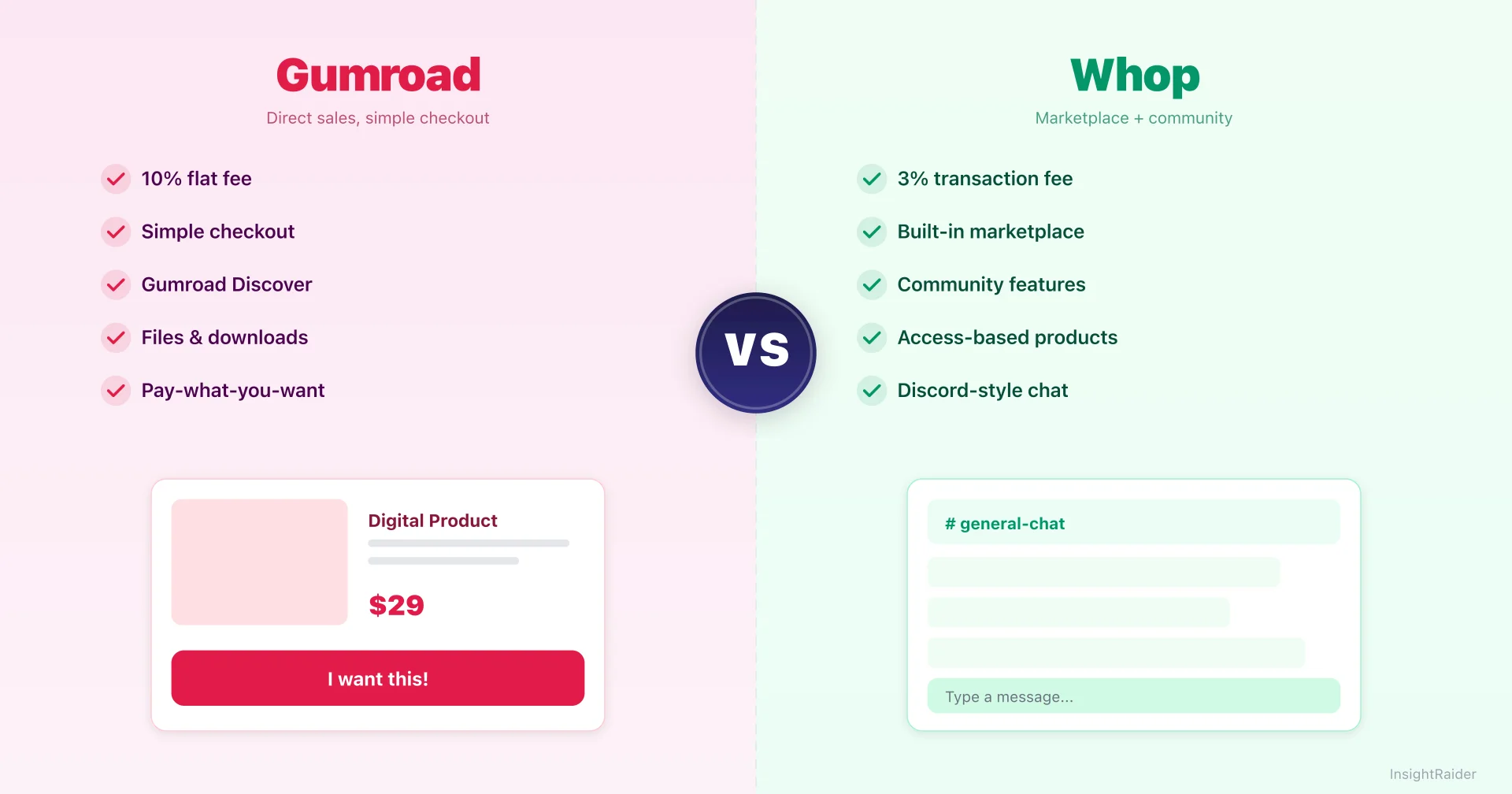
Gumroad vs Whop: Which Platform Should You Use in 2026?
One takes 10% + $0.50 per sale, plus card processing. The other takes no platform fee at all. You'd think the choice is obvious. It isn't.
Gumroad and Whop look like competitors, but they're built on opposite philosophies. Gumroad is a checkout page you can set up in five minutes. Whop is a marketplace where buyers come looking for products. One gives you a tool. The other gives you an audience. And the right pick depends entirely on what you sell, who you sell to, and how your business works.
This comparison separates provider documentation, worked fee examples and public market estimates. It is not a representative study of creator outcomes.
Quick Overview: Direct Sales vs Marketplace
Gumroad is a creator-first checkout platform. You upload a product, set a price, get a link. Share that link on Twitter, your blog, your email list, wherever. Gumroad handles payments and file delivery. That's it. No marketplace pushing your product to strangers. Your traffic, your sales. For a full walkthrough, check our guide on how to sell digital products on Gumroad.
Whop is a marketplace-first platform. Think of it as the app store for digital products. Buyers browse Whop's marketplace, discover products organically, and buy without ever visiting your website. Whop also handles Discord-style community features, membership gating, and access-based products. For more on how the Whop ecosystem works, see our Whop marketplace guide.
The core tension: Gumroad expects you to bring your own audience. Whop helps you find one.
If you don't have an audience, that distinction matters. A lot.
Feature-by-Feature Comparison
Discovery and Marketplace
Gumroad:
- Gumroad Discover exists, but it's secondary to the platform's purpose
- Most creators drive their own traffic (social media, blogs, email)
- Discovery is a bonus, not a business model
- Public product listings can support offer research; a selected archive is not a current representative marketplace census.
Whop:
- Marketplace is the core experience
- Buyers browse categories, trending products, and recommendations
- Built-in search and ranking algorithms
- Social proof (reviews, user counts) displayed prominently
- Marketplace discovery matters most for new sellers who have no audience yet
Winner: Whop, decisively. If you have no audience and need organic discovery, Whop's marketplace is a genuine distribution channel. Gumroad Discover exists but rarely moves the needle for unknown creators.
Fees and Pricing Model
Gumroad:
- $0/month
- 10% + $0.50 per transaction on direct sales
- Payment processing (2.9% + $0.30) charged on top, not included
- No feature gating behind plans
- Simple, predictable, expensive at scale
Whop:
- $0/month
- No platform fee listed
- Payment processing: 2.7% + $0.30 per domestic card transaction
- International cards add 1.5%; next-day ACH payouts cost $2.50
- No tiered pricing, no premium plans
Winner: Whop on raw fees. On a $100 domestic card sale, Whop's listed fees total $3.00 vs $13.70 on Gumroad. But fees aren't the whole story -- read the pricing deep dive below.
Community Features
Gumroad:
- No built-in community tools
- Email broadcasts to buyers (basic)
- Relies on external tools (Discord, Circle, Slack) for community
- Webhooks and API to connect community platforms
Whop:
- Built-in chat rooms and community spaces
- Discord-style channels inside the Whop dashboard
- Membership gating (free, paid, tiered)
- Content feeds, announcements, and member directories
- Native community engagement metrics
Winner: Whop, no contest. If community is part of your product, Whop builds it right in. Gumroad requires you to stitch together external tools and manage access manually. That's wasted time. Weighing dedicated community platforms instead? See Skool vs Discord: which is better.
Simplicity and Setup
Gumroad:
- Live in under 5 minutes
- Upload file, set price, share link
- Interface is famously clean and minimal
- Almost zero learning curve
- "Pay what you want" pricing option
Whop:
- More setup steps (product listing, marketplace optimization, community configuration)
- Dashboard is feature-rich but busier
- Learning curve for marketplace SEO and product positioning
- More powerful, but more to learn
Winner: Gumroad. If you want the fastest path from "I have a file" to "someone can buy it," nothing beats Gumroad's simplicity. Whop trades simplicity for capability.
Subscriptions and Memberships
Gumroad:
- Recurring subscriptions supported
- Simple monthly/annual billing
- Subscriber management dashboard
- No membership tiers within a single product
- Cancel/pause handled automatically
Whop:
- Subscriptions are a first-class feature
- Multiple membership tiers per product
- Free trial support
- Access-gated content and community
- Automatic role management
- Usage-based or time-based access options
Winner: Whop. Both platforms handle recurring billing, but Whop was designed around memberships. If your business model is "pay monthly for access to X," Whop's tooling is more mature and flexible.
Course Hosting
Gumroad:
- File delivery (PDF, video, zip)
- No native course player
- No drip content or progress tracking
- Essentially a download service
Whop:
- Built-in course module
- Lesson sequencing and drip content
- Progress tracking for members
- Integrates with community features (discussion alongside lessons)
- Not as polished as dedicated course platforms, but functional
Winner: Whop. Neither platform competes with Teachable or Thinkific for course delivery. But Whop offers a usable course experience natively, while Gumroad just delivers files.
API and Integrations
Gumroad:
- Full public API
- Zapier (5,000+ app connections)
- Direct integrations: Discord, ConvertKit, Mailchimp, Circle
- Webhooks for custom workflows
- Embeddable checkout widgets
Whop:
- API available for developers
- Webhooks for key events
- Discord bot integration (auto-role assignment)
- Fewer third-party integrations than Gumroad
- Growing ecosystem, but younger
Winner: Gumroad. Gumroad's API is more mature and its integration ecosystem is broader. If you need your sales platform to talk to a dozen other tools, Gumroad plays nicer.
Pricing Deep Dive: The Real Math
Let's run three scenarios. Gumroad charges 10% + $0.50 per direct sale, plus payment processing (2.9% + $0.30). Whop charges no platform fee, only payment processing (2.7% + $0.30 per domestic card). Both examples assume US domestic cards and exclude taxes, refunds, international cards, currency conversion, optional Whop services (such as billing or tax handling) and payout fees. Fees checked September 23, 2026 on and .
Scenario 1: $500/month Revenue
Gumroad (~40 sales at $12.50 avg):
- Gumroad fee: $70 (10% + $0.50 per sale)
- Payment processing (2.9% + $0.30 per sale): $26.50
- You keep: $403.50
Whop:
- Platform fee: $0
- Payment processing (2.7% + $0.30 per sale): $25.50
- You keep: $474.50
Difference: Whop saves you $71/month. On small orders, Gumroad's $0.50 per sale adds up fast.
Scenario 2: $2,000/month Revenue
Gumroad (~40 sales at $50 avg):
- Gumroad fee: $220 (10% + $0.50 per sale)
- Payment processing: $70
- You keep: $1,710
Whop:
- Platform fee: $0
- Payment processing: $66
- You keep: $1,934
Difference: Whop saves you $224/month.
Scenario 3: $10,000/month Revenue
Gumroad (~200 sales at $50 avg):
- Gumroad fee: $1,100 (10% + $0.50 per sale)
- Payment processing: $350
- You keep: $8,550
Whop:
- Platform fee: $0
- Payment processing: $330
- You keep: $9,670
Difference: Whop saves you $1,120/month. That's $13,440/year. Not nothing.
The takeaway: Whop is cheaper at every tier, by roughly 11 to 14 points of revenue under these assumptions. International cards (+1.5% on Whop) and payout fees narrow the gap slightly, but don't close it. The real question isn't which platform costs less -- it's which one helps you reach those revenue numbers in the first place.
Product-Market Fit: What You Sell Decides the Platform
This is where most creators go wrong. They compare features and fees, then pick the "better" platform. But the right platform depends entirely on your product type.
Gumroad excels at:
- Downloadable files (ebooks, templates, presets, fonts, icons)
- One-time purchase digital goods
- Products where the buyer downloads and leaves
- Simple, self-explanatory products that don't need community or support
- Offers whose buyer, delivery and acquisition assumptions fit Gumroad
Whop excels at:
- Access-based products (trading signals, private communities, exclusive content)
- Membership programs with ongoing value delivery
- Products where community is part of the value proposition
- Subscription-based services (software access, recurring content)
- Products in finance, trading and other "hustle" niches, which are prominent in Whop's marketplace categories
If you sell a Notion template pack, Gumroad. If you sell access to a trading Discord with daily signals, Whop. The product type drives the platform choice, not the fee structure. Don't overthink this.
Audience Demographics: Know Your Buyer
This is an underrated factor. Gumroad and Whop attract very different buyer populations. The notes below are editorial observations of each platform's categories and buying model, not survey data.
Gumroad's audience:
- Broad creator economy: designers, writers, developers, educators, musicians
- Buyers come from the creator's own channels (Twitter, YouTube, newsletters)
- Comfortable buying digital downloads and supporting independent creators
Whop's audience:
- Marketplace categories lean toward finance, trading, crypto, sports betting, and "hustle" niches
- Buyers browse the marketplace looking for an edge
- More likely to pay for access and community than for static files
- Higher tolerance for subscription-based purchases
- Growing but still niche compared to Gumroad's breadth
Why this matters: If you sell a photography course for hobbyists, Whop's audience will mostly ignore you. If you sell a forex signal group, Gumroad's audience won't find you. Know where your buyers already hang out. This isn't optional -- it's the foundation of your distribution strategy.
The Hybrid Strategy: Use Both
Most comparison articles miss this: you can run products on both platforms simultaneously.
This isn't about hedging. It's about playing to each platform's strengths.
Example setup:
- Gumroad for your template pack ($19-39). Upload the files, share on social media, let Gumroad handle delivery. Simple transaction, done.
- Whop for your premium community ($29-99/month). Gate access to your Discord, course content, and live sessions behind a Whop membership. Use the marketplace for organic discovery.
The workflow:
- Create a low-ticket product on Gumroad to validate demand and build an audience
- Launch a higher-ticket membership on Whop for your most engaged buyers
- Use Gumroad purchases as a funnel into the Whop community
- Keep both listings active -- different products, different buyer intents, same brand
As an illustrative setup, a Gumroad template can serve as a lead generator for a Whop membership: a $19 template buyer may later join a $49/month community. That's not platform disloyalty. That's a funnel.
For pricing strategies that work across both platforms, see our digital product pricing guide.
The Decision Checklist
Still weighing your options? Go through this list.
Choose Gumroad if:
- You sell downloadable files (ebooks, templates, presets, code)
- You already have an audience on social media, YouTube, or email
- You want to go live in under 10 minutes
- You prefer simplicity over advanced features
- Your products are one-time purchases
- You sell across many niches (design, writing, education, music)
- You want a mature API and integration ecosystem
- You hate managing community tools inside your sales platform
Choose Whop if:
- You sell access-based products (communities, signals, memberships)
- You don't have an audience and need marketplace discovery
- You want built-in community features (chat, forums, gated content)
- Your audience is in finance, trading, or hustle niches
- Recurring subscriptions are your primary revenue model
- You want lower transaction fees
- You need membership tiers with different access levels
- Community engagement is part of your product's value
Count your checks. The platform with more is your starting point.
How InsightRaider Helps You Decide
Picking the platform is step two. Step one is making sure you have a product people actually want.
The graveyard of digital products isn't filled with creators who picked the wrong platform. It's filled with creators who picked the wrong niche. They didn't validate. They didn't check the data. They launched blind.
InsightRaider gives you the data to skip the guesswork:
- Compare similar offers. Browse modeled revenue estimates for comparable digital products on Gumroad, Whop and Skool. They are labeled as estimates, not audited sales.
- Find gaps in the market. Look for buyer needs that existing offers cover poorly, then check them against your own audience.
- Check demand before you build. Before spending weeks on a course or template pack, look at how similar offers are priced, reviewed and positioned. Weak signals are a reason to dig deeper, not a verdict on your idea.
- Compare equivalent terms. Inspect the buyer, scope, license and support of relevant offers, then test your own price using independent purchase records.
- Review dated observations. Coverage varies by product and marketplace, so compare periods only when the observation dates line up.
The platform is the vehicle. The product is the destination. Make sure you're driving somewhere worth going.
The Bottom Line
Choose Gumroad if you sell files and have your own audience. It's fast, simple, and stays out of your way. The 10% + $0.50 per sale, plus processing, hurts at scale, but the zero-friction setup is unmatched. Best for creators who want a checkout page, not a platform.
Choose Whop if you sell access and need a marketplace. Lower fees, built-in community, and organic discovery for the right niches. Best for membership-based businesses in finance, trading and other hustle-oriented niches.
Choose both if your business has products that fit each platform. A template on Gumroad and a community on Whop isn't redundancy -- it's strategy.
And before you stress about the platform, stress about the product. A validated idea on either platform beats a brilliant setup with nothing worth buying. Compare Gumroad to other alternatives too, and make sure you're looking at the full picture before committing.
Fees matter less than demand. Before choosing between Gumroad and Whop, check that buyers already pay for offers like yours. InsightRaider shows modeled revenue estimates for comparable offers on Gumroad, Whop and Skool, so you can compare markets first, then the tool. Compare similar offers before you compare features.
Got more questions? Check out our data-driven answers:
- What are the best Gumroad alternatives?
- Is Gumroad still worth it?
- Why are creators leaving Gumroad?
- How to make money clipping on Whop?
- Skool vs Kajabi: which is better?
More comparisons: Whop vs Systeme.io · Whop vs Lemon Squeezy