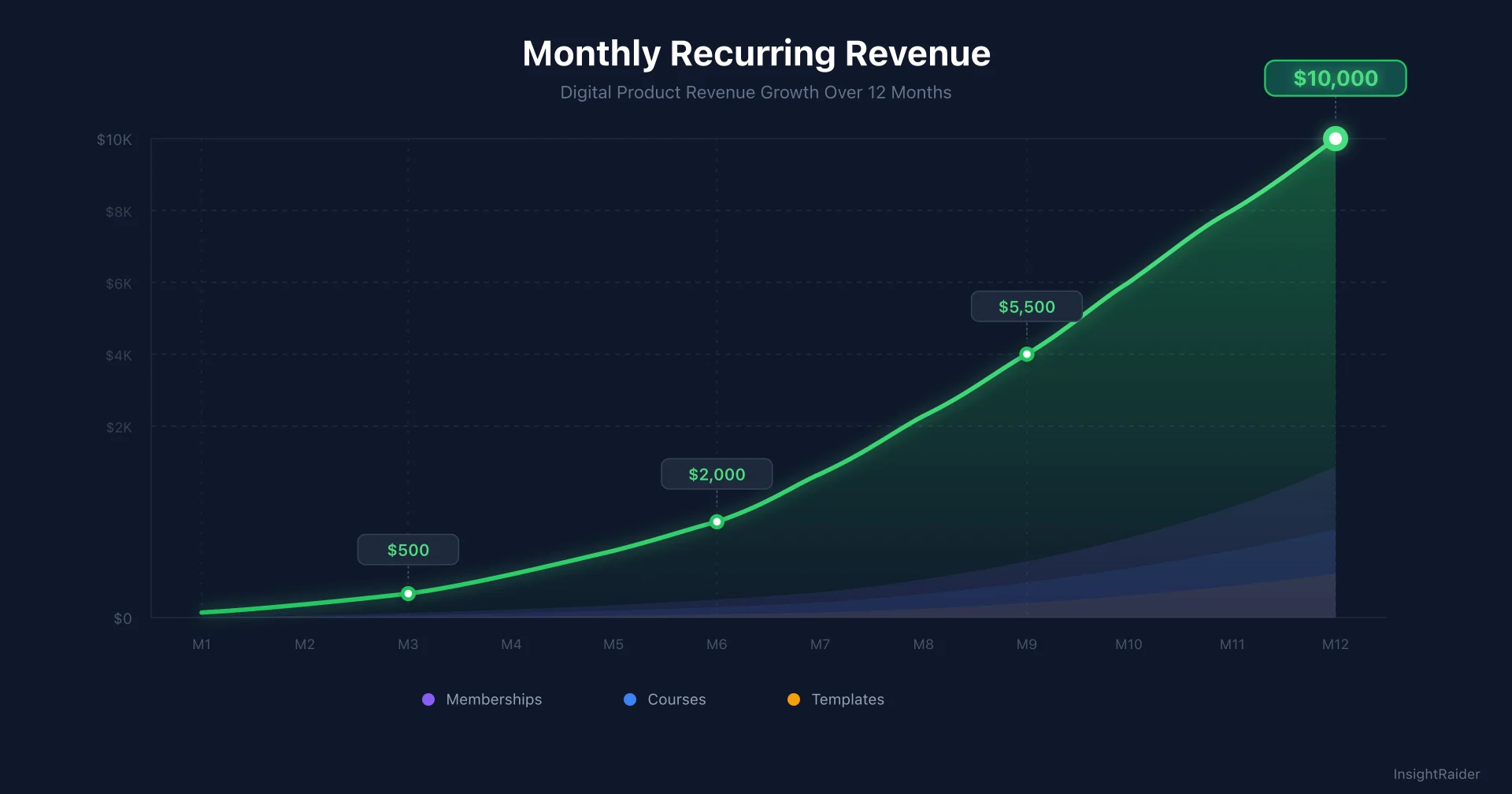
You launched a course. It sold well for two weeks. Then the revenue flatlined. So you launched another product. Same spike, same crash.
That's the revenue roller coaster. And you're stuck on it because you built a one-time-sale business in a subscription world.
The math is brutal: if your average product sells for $49 and you need $10,000/month to live, you need 204 new customers every single month. Miss a launch? Income craters. Get sick for a week? Revenue disappears.
Creators who build recurring revenue sleep better and plan further ahead. Instead of starting each month at $0, they start with last month's subscribers, minus whoever cancelled.
That's not a nice-to-have. That's a fundamentally different business.
The One-Time Sales Trap
One-time sales aren't inherently bad. They're a great way to validate an idea and generate quick cash. But as a long-term business model, they come with serious structural problems.
The launch dependency cycle: Your revenue is directly tied to how often you launch. No launch, no money. This forces you into a constant content creation grind where you're always building the next thing instead of improving what you already have.
Zero compounding: Every month you start from scratch. A hypothetical subscription business with 200 members at $29/month starts every month at $5,800 before doing anything. A one-time product creator starts at $0. Which one would you rather be?
Customer lifetime value ceiling: When someone buys your $49 ebook, the transaction is over. With a subscription, that same customer could pay you $49 every month for two years, turning a $49 transaction into a $1,176 relationship.
Acquisition cost pressure: Acquiring a subscriber often takes about the same effort as acquiring a one-time buyer. But a subscriber who stays can pay you many times more over their lifetime. This means you can spend more on marketing, afford more paid ads, and outcompete creators still running the launch-to-launch game.
Five Recurring Revenue Models That Work for Digital Products
Not all subscription models are equal. These five fit digital products best, because each one gives buyers a reason to keep paying.
1. Membership Sites
How it works: Customers pay monthly or annually for access to an evolving library of content, resources, or training.
Best for: Educators, coaches, and experts with a deep body of knowledge
Membership sites work because the content library grows over time, making the product more valuable the longer it exists. A new member joining today gets access to 18 months of accumulated material. That's an incredible value proposition.
Keys to success:
- Release new content on a predictable schedule (weekly or biweekly)
- Create a clear content roadmap so members see what's coming
- Build a "greatest hits" onboarding sequence so new members immediately get value
- Add community elements to create social switching costs
2. Paid Communities
How it works: Members pay for access to a private group (Discord, Circle, Skool) where they get peer support, expert Q&A, accountability, and networking.
Best for: Creators with engaged audiences who value connection and accountability
The insight most people miss: the community itself is the product. You're not selling content. You're selling access to a curated room of motivated people working toward similar goals. Content is supplementary. Platforms like Whop are purpose-built for this model: our Whop marketplace guide covers how to set one up.
Keys to success:
- Maintain high signal-to-noise ratio by curating membership
- Show up consistently (daily or near-daily engagement from you)
- Create structured events: weekly calls, monthly challenges, AMAs
- Make member outcomes visible to inspire retention
3. Subscription Content (Newsletters, Podcasts, Video Series)
How it works: Free content attracts an audience, premium content behind a paywall generates recurring revenue.
Best for: Writers, analysts, and niche experts who can produce consistent premium insights
Paid newsletters are an established model. Platforms like Substack, Beehiiv, and Ghost exist because people pay for expertise they can't get from a Google search or a ChatGPT prompt.
Keys to success:
- Free content must be genuinely good to build trust
- Premium content must be actionable, not just informative
- Publish on a strict schedule (paid subscribers expect reliability)
- Give subscribers an identity: they're "insiders" with access others don't have
4. Template and Asset Libraries
How it works: Instead of selling individual templates, sell a subscription to an ever-growing library of templates, presets, assets, or tools.
Best for: Designers, developers, copywriters, and anyone who creates reusable assets
This model works especially well in professional contexts. In a hypothetical example, a marketing manager who pays $19/month for access to 500+ email templates and landing page designs gets far more value than buying individual templates at $9 each.
Keys to success:
- Add new assets regularly (minimum weekly)
- Organize the library impeccably with search, tags, and categories
- Include usage guides and customization tutorials
- Offer bulk download and team licensing options
5. Micro-SaaS and Digital Tools
How it works: Build lightweight software tools (Notion dashboards, Airtable bases, spreadsheet systems, browser extensions) that solve a specific problem for a specific audience.
Best for: Technically-inclined creators who can build and maintain simple tools
The line between "digital product" and "software" is blurring. A Notion-based project management system that auto-updates, syncs, and evolves is functionally a SaaS product. Customers are happy to pay monthly because they rely on it daily.
Keys to success:
- Solve a problem people encounter repeatedly (daily or weekly)
- Provide ongoing updates and improvements
- Offer customer support and documentation
- Build integrations with popular tools in your niche
How to Convert a One-Time Product into Recurring Revenue
You don't need to start from scratch. Many subscription products evolve from one-time sales.
The Expansion Strategy
Take your best-selling one-time product and ask: "What would make someone want to keep paying?"
- A Notion template becomes a subscription when you add monthly template drops, a community, and priority support.
- An ebook becomes a membership when you add a private podcast, monthly deep dives, and a discussion forum.
- A course becomes a subscription when you add ongoing coaching calls, updated modules, and peer accountability groups.
The Tier Approach
Don't eliminate your one-time product. Layer a subscription on top of it.
Tier 1 - One-time purchase ($49-149): The core product. No changes. Tier 2 - Monthly subscription ($19-49/month): The core product plus ongoing updates, community access, and new content. Tier 3 - Premium subscription ($79-199/month): Everything in Tier 2 plus direct access to you (office hours, group coaching, feedback).
This lets existing customers upgrade naturally and gives new customers options at every price point.
The Value Ladder
Start with a free lead magnet. Convert to a low-price one-time product. Then offer the subscription as the next logical step.
Free: Weekly newsletter with one actionable tip $29 one-time: The complete framework guide $19/month: Monthly implementation workshops, community, new templates $99/month: Group coaching, direct feedback, priority access
Each step builds trust and demonstrates value, making the subscription an obvious next move rather than a leap of faith.
Pricing Your Subscription: What to Decide
Pricing is where most creators either leave money on the table or kill their product before it gains traction.
Monthly vs. Annual
Offer both. Always.
- Monthly reduces the barrier to entry and lets skeptical buyers test with low risk
- Annual improves your cash flow and removes monthly cancellations for the year
- A common convention is to price annual plans at 10 months' worth of the monthly price (a 17% discount). The discount feels meaningful without destroying your revenue
Price Anchoring That Works
A common structure uses three tiers:
| Tier | Price Range | Purpose |
|---|---|---|
| Basic | $9-19/month | Entry point, content access only |
| Standard | $29-49/month | Full access, community, most popular |
| Premium | $79-199/month | Direct access, coaching, enterprise |
The middle tier should be the one you want most people to pick. The bottom tier exists to make the middle feel like a deal. The top tier exists to make the middle feel reasonable. For a deeper dive into the psychology behind these numbers, see our digital product pricing strategies guide.
The "$29 Floor" Rule
A working assumption worth checking in your own data: very cheap subscriptions (under $19/month) tend to attract casual sign-ups. Low-price subscribers are less committed. They signed up casually and cancel casually.
A $29-49/month price filters for buyers who are serious about getting value. Expect them to engage more and stay longer, then verify it with your churn numbers.
If your audience can't justify $29/month, you're targeting the wrong audience or not communicating enough value. Fix one of those two things.
Retention: The Real Game
Acquiring a subscriber is only half the battle. Keeping them is where real revenue gets built. A subscription with 10% monthly churn loses half its members every 7 months. A subscription with 3% monthly churn retains half its members for nearly 2 years.
The First 30 Days Determine Everything
The first month is the riskiest one. If a member doesn't experience a meaningful "win" in their first month, they're likely gone.
Build a deliberate onboarding sequence:
- Day 1: Welcome email with the single most valuable resource in your library
- Day 3: Quick win tutorial they can implement in 15 minutes
- Day 7: Introduction to the community with a conversation prompt
- Day 14: Check-in email asking about their progress
- Day 21: Showcase a member success story to reinforce the decision to join
- Day 30: Invitation to a live session or call
Engagement Loops That Reduce Churn
The best subscription products create habits:
- Weekly rituals: A live call every Tuesday, a new resource every Friday. Predictability builds habits.
- Progress tracking: Let members see how far they've come. Dashboards, milestones, and badges work.
- Social accountability: Pair members up or create small groups. People are less likely to cancel when other people are counting on them.
- Surprise value: Unexpected bonuses, guest expert sessions, or free 1-on-1 calls for active members. This creates delight that is hard for a competitor to copy.
The Cancellation Interview
When someone cancels, ask them one question: "What would have made you stay?"
This data is gold. After 50-100 cancellation responses, you'll see patterns. Maybe members want more live interaction. Maybe the content schedule is too slow. Maybe they feel overwhelmed by the volume. Each of these is fixable, and fixing them compounds your retention over months and years.
Three Recurring Revenue Scenarios
These are hypothetical scenarios built to show how each model works, not documented customer results. The revenue lines are simple arithmetic (price × members), not forecasts.
The Notion Template Creator Who Builds a Library Subscription: Sells individual Notion templates at $19-39 each. Revenue is inconsistent, peaking during launches and dying between them. Shifts to a $29/month template library with 200+ templates, weekly additions, and a members-only Discord. If 620 subscribers stay, that is about $18k/month; the number that decides it is monthly churn.
The Marketing Educator Who Launches a Paid Community: Has a course that sells well at $149 but generates zero revenue between launches. Creates a $49/month community on Skool with weekly strategy calls, swipe file updates, and peer feedback sessions. At 450 members, the community would bring in about $22k/month, more than most launch months.
The Designer Who Builds a Subscription Asset Library: Sells individual UI kits for $29-59 on Gumroad. Creates a $15/month subscription with access to every kit plus monthly additions. At 800 subscribers, that is $12k/month. The lower price point only pays off if members stay long enough to beat a one-time kit purchase.
The Common Thread: In each scenario, the creator already has a proven product and an audience. They don't start with subscriptions. They graduate to them after establishing credibility and understanding what their customers value most. For a realistic look at how creators scale from nothing to consistent five-figure months, see our from zero to $10K/month roadmap.
How InsightRaider Identifies Niches with Strong Recurring Revenue Potential
Building recurring revenue starts with picking the right niche. Not every market supports subscriptions equally. Some niches have audiences that expect ongoing value and will happily pay monthly. Others have audiences that buy once and disappear.
Look for these signals before you commit. InsightRaider helps with the ones visible in public listings across Gumroad, Whop and Skool: prices, offer formats and modeled sales estimates.
Repeat purchase rates: If buyers in a niche frequently purchase multiple products from the same creator, that's a strong signal for subscription potential. These buyers want an ongoing relationship, not a one-time transaction.
Content velocity tolerance: Some niches expect constant updates (marketing, AI, social media strategy). Others are more static (fundamental skill courses). High-velocity niches are natural fits for subscriptions because the content genuinely needs refreshing.
Community engagement signals: Niches where buyers actively comment, share, and discuss products are more likely to support a community or membership. Reviews and active community offers are a useful proxy.
Price sensitivity patterns: Compare how offers are priced within a niche. Niches where mid-tier pricing ($29-79) is common are good candidates for subscriptions. Niches dominated by $9 products often have audiences unwilling to commit monthly.
Competitor subscription adoption: If established creators in a niche already sell memberships on Whop or Skool, buyers there are used to paying monthly. Check how many comparable recurring offers exist and how they are priced.
When you combine these signals, you get a clearer picture of which niches can sustain recurring revenue and which ones are better suited to one-time sales. Research your niche before you build, then confirm with your own buyers.
Your Recurring Revenue Action Plan
Stop reading and start building. Here's your 30-day roadmap:
Week 1: Audit and decide
- Review your existing products and audience
- Identify which product has the highest engagement and repeat interest
- Choose one recurring model from the five above
Week 2: Design and price
- Map out what your subscription includes at launch
- Set up 2-3 pricing tiers with monthly and annual options
- Build your first 30 days of onboarding content
Week 3: Soft launch
- Invite your best existing customers at a "founding member" discount
- Collect feedback aggressively during the first week
- Iterate on the offering based on real member behavior
Week 4: Optimize and grow
- Refine your onboarding based on early member feedback
- Set up churn tracking and cancellation surveys
- Begin planning your public launch with confidence
Launch-dependent revenue resets every month. Subscription revenue carries over. The creators who make this transition keep building on last month's members while others keep riding the roller coaster.
Which side do you want to be on?
Want to find niches where recurring offers already exist? Compare offers to review pricing, offer formats and modeled sales estimates before you commit to building.
Got more questions? Check out our data-driven answers:
- What are the best recurring revenue digital products?
- What is the best platform for passive income digital products?
- Skool vs Patreon: which is better?
- How much money can you make on Skool?
More comparisons: Gumroad vs Patreon