From $0 to $10K/Month Selling Digital Products: The Math
Picture two hypothetical creators who launch digital products on Gumroad in the same week. Same niche. Similar quality. One picks a validated niche, prices with intent and promotes every week. The other lists a product, posts about it twice and waits.
Six months later, they are in very different places. The difference isn't talent, audience size, or marketing budget. It's methodology: a specific sequence of decisions about niche selection, pricing, product breadth, and distribution.
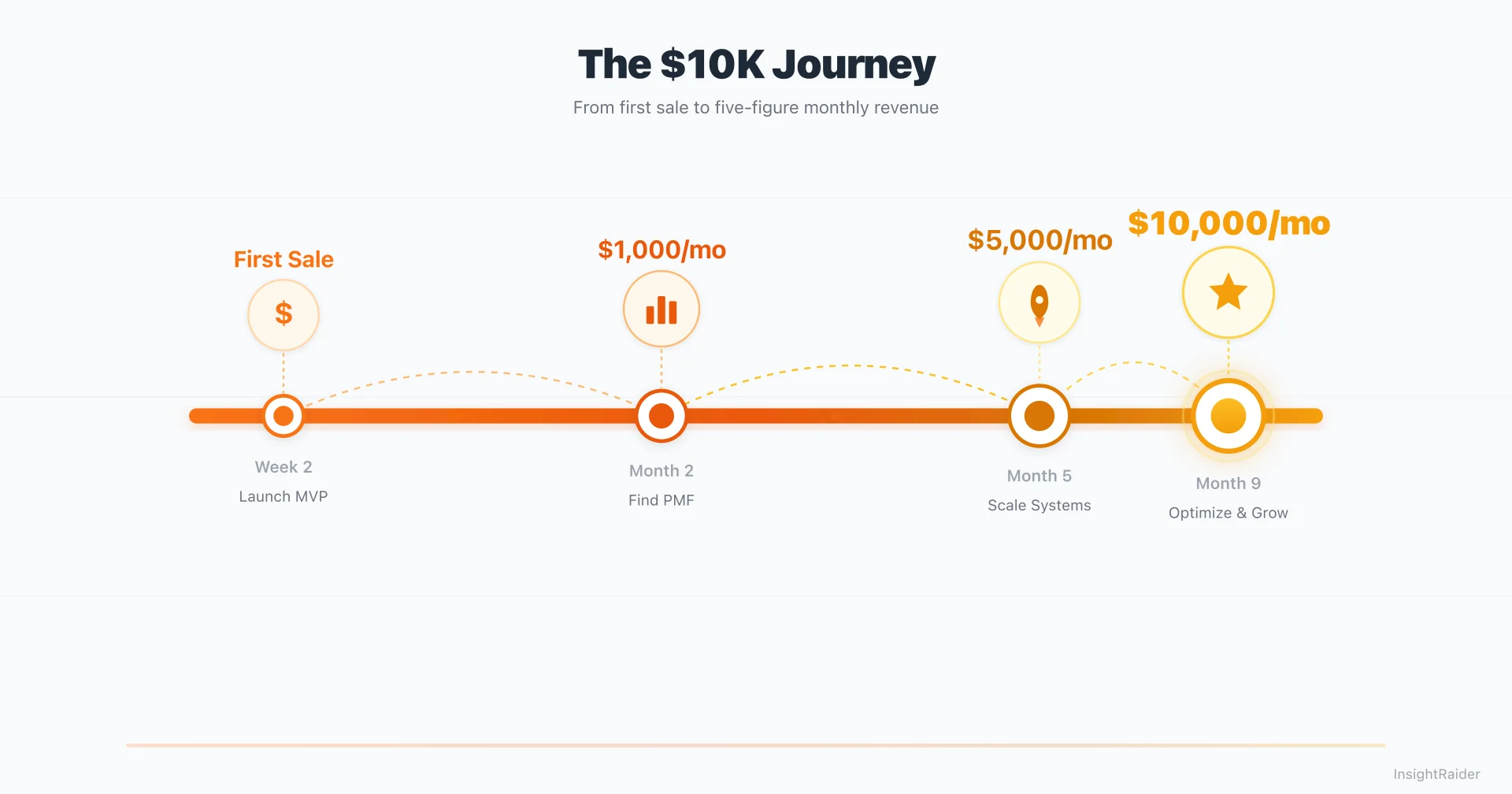
This guide breaks the path from $0 to $10K/month into three phases, with the sales math, the plateaus and the priorities of each. Every conversion rate, timeline and revenue mix below is a planning assumption, not a measured average, so swap in your own numbers as soon as you have them.
No sugarcoating. No "just believe in yourself." Math you can check.
The Revenue Distribution Nobody Talks About
Before the roadmap, you need to understand the terrain. Digital product revenue isn't a bell curve. It's a power law, and a brutal one.
In InsightRaider's State of Gumroad 2026 dataset (146,271 Gumroad products, January to April 2026), the top 1% of products captured 77.3% of tracked revenue, while only 12,952 products (8.9%) carry a recorded sales count at all. These are modeled estimates built from public signals (methodology) and they count products, not creators, but the shape is unmistakable: a few listings earn most of the money.
But here's what nobody mentions: those numbers include everyone. The person who listed a half-finished PDF and never promoted it. The creator who launched once, got three sales, and quit. The hobbyist who treats it like a lottery ticket.
This guide is about doing the opposite: validating before building, launching at least two products, and promoting consistently for 6+ months. No dataset here measures exactly how much that improves your odds, but each habit removes a common reason a listing sits at $0. (For a worked scenario of this pattern, read our Gumroad creator success story.)
The difference isn't talent. It's methodology, and not being lazy about the fundamentals.
Phase 1: $0 to $1K/Month (Months 1-3)
This is where many creators get stuck for good. Not because the goal is hard, but because they focus on the wrong things.
What $1K/month actually requires:
| Price Point | Monthly Sales Needed | Daily Traffic (assuming 2% conversion) |
|---|---|---|
| $19 | 53 sales | ~88 visitors/day |
| $39 | 26 sales | ~43 visitors/day |
| $59 | 17 sales | ~28 visitors/day |
| $99 | 11 sales | ~18 visitors/day |
Look at the $99 row. Eleven sales a month. That's one sale every three days. Eighteen visitors per day. That's achievable with a single well-performing Reddit post, a small email list, or a handful of community contributions.
If you can't get 18 visitors a day to your product page, the problem isn't the market. It's you.
What to focus on in this phase:
1. Pick a validated niche, not an interesting topic. Before quality, marketing, or audience size, check whether someone else is already making money in that niche. If competitors exist and show signs of revenue (reviews, multiple price tiers, steady updates), there's demand to test. If you can't find competitors, that's usually a warning sign, not an opportunity. InsightRaider's modeled estimates for dated product observations across Gumroad, Whop and Skool can speed up that check. Our guide on how to find a profitable niche walks through this step in detail.
2. Start with a template, toolkit, or resource, not a course. Why? Lower perceived risk for the buyer. A $49 template collection is an easier "yes" than a $199 course from someone they've never heard of.
3. Price between $29 and $79. First-time creators often underprice, and a very low price can signal low value. A reasonable starting range for a first product is $39-$59: accessible enough for impulse buying, high enough to signal quality. Then test. Our digital product pricing strategies guide covers seven tactics for maximizing revenue at every price point.
4. Sell where your audience already hangs out. Don't build a website. Don't set up complex funnels. List on Gumroad or Lemonsqueezy, then go where your target customers already gather. Subreddits, Slack groups, Discord servers, niche Facebook groups, indie hacker communities. Contribute value first. Mention your product second.
Planning timeline (an assumption, not an average): 4-8 weeks to validate and build your first product. 4-8 weeks of consistent promotion to reach $1K/month. Skip validation and the clock usually runs much longer, because you find out the niche is wrong only after you've built for it.
Phase 2: $1K to $5K/Month (Months 3-9)
Reaching $1K proves the concept. Getting to $5K requires a fundamentally different skill: product-market fit optimization.
At this stage, your product works but doesn't scale. You're probably generating most sales from manual outreach, one-off posts, and direct messages. That's fine for $1K. It's exhausting and unsustainable at $5K.
The math changes:
| Price Point | Monthly Sales Needed | Daily Traffic (assuming 3% conversion) |
|---|---|---|
| $49 | 102 sales | ~113 visitors/day |
| $79 | 64 sales | ~71 visitors/day |
| $99 | 51 sales | ~57 visitors/day |
Notice the assumed conversion rate jumped from 2% to 3%. That's intentional. By this phase, you should be optimizing your sales page, collecting testimonials, and refining your positioning. Going from 2% to 3% conversion means 50% more sales from the same traffic, which is often cheaper than finding 50% more visitors.
What to focus on in this phase:
1. Build a repeatable traffic engine. Choose one organic channel and dominate it. Not three. Not all of them. One channel, executed consistently for six months, usually beats scattered effort across five channels.
Four channels worth considering for digital products in 2026:
- SEO content (long-tail articles targeting buyer-intent keywords): Slow to build, highest long-term ROI
- Twitter/X threads (value-first content in your niche): Fastest audience growth for B2B products
- YouTube tutorials (teaching related skills): Highest trust-building, best for $99+ products
- Newsletter (weekly value delivery): Best for repeat purchases and launches
Pick one. Execute. Stop dabbling.
2. Launch a second product. The value isn't just a second revenue line. It's cross-selling: a customer who already bought your $49 template pack is a far warmer prospect for your $79 advanced toolkit than a cold visitor.
Your second product should be either:
- A higher-tier version of your first product (advanced templates, premium features)
- A complementary product solving an adjacent problem for the same audience
3. Raise your prices. If you launched at $39, test $59. If you launched at $59, test $79. Compare conversion rate and revenue per visitor over comparable periods before and after: a small dip in conversion can still mean more total revenue.
You're probably underpricing right now. Test a higher price this week.
4. Build an email list obsessively. Create a free lead magnet (a mini version of your paid product, a checklist, or a quick-win resource). Gate it behind an email signup. Every community post, every piece of content, every social media bio should drive to this lead magnet.
The math is simple. Suppose 2,000 engaged subscribers each have a 2% chance of buying a $79 product in a given month (an assumption to replace with your own data): that's about 40 sales, or roughly $3,160. That's the backbone of a $5K/month business.
Planning timeline: 3-6 months of consistent execution after hitting $1K. The biggest variable is usually channel selection: every time you bounce to a new channel, you restart the slow part of building it.
Phase 3: $5K to $10K/Month (Months 9-18)
This is where digital products stop being a side hustle and start being a business. The leap from $5K to $10K is less about doing new things and more about systematizing what already works.
The math at $10K/month:
| Strategy | Revenue Contribution |
|---|---|
| Product A ($59) at 60 sales/month | $3,540 |
| Product B ($99) at 35 sales/month | $3,465 |
| Product C ($149) at 12 sales/month | $1,788 |
| Email launch to list (quarterly) | ~$1,500/quarter = $500/month avg |
| Affiliate revenue | ~$700/month |
| Total | ~$10,000/month |
This is an illustrative portfolio: every price and volume in it is an assumption. But the structure is the point. Three products at different price points, a growing email list, and a small affiliate program.
What to focus on in this phase:
1. Create a product ladder. You need at least three products at different price tiers:
- Entry product ($29-$59): High volume, low friction. This is your customer acquisition tool.
- Core product ($79-$149): Your primary revenue driver. Highest perceived value relative to price.
- Premium product ($199-$499): Lower volume, highest margin. Often includes personal elements like community access, coaching calls, or done-for-you components.
Each tier should naturally lead to the next. The buyer of your $39 template pack should clearly see why the $99 toolkit is the logical next step.
2. Automate the sales process. By $5K/month, you can't rely on manual outreach. Set up:
- An automated email welcome sequence (5-7 emails over 14 days)
- Post-purchase upsell flows (recommending the next product)
- Evergreen content that drives consistent organic traffic
- A weekly or biweekly newsletter that provides value and soft-sells products
3. Launch a high-ticket offer. Often the shortest path from $5K to $10K is adding a premium offer. A $299-$499 cohort-based workshop, a small-group coaching program, or a done-with-you implementation package. Ten sales a month at this price point adds roughly $3K-$5K in revenue.
4. Build partnerships and affiliates. Reach out to newsletter writers, YouTubers, and community leaders in your niche. Offer 30-40% affiliate commissions. A single partnership with a well-aligned creator can become a steady source of referral sales.
Planning timeline: 6-12 months after reaching $5K. This phase feels slower because the wins are incremental: for example, a 0.5% conversion improvement here, a new product contributing $1,200/month there, an affiliate deal adding $400/month. Stacked together, small gains like these cross the $10K threshold.
The Three Plateaus (and How to Break Through)
Expect three kinds of walls. The dollar figures below are rough markers, not measured thresholds. Knowing the walls are coming doesn't make them painless, but it does make them survivable.
Plateau 1: The $300/month wall. Your first product launches, gets some initial sales, then flatlines. This is usually a distribution problem, not a product problem. Fix: commit to one channel and post/contribute 5x per week for 60 days straight. Quitting at week two is the easy mistake. Don't make it.
Plateau 2: The $2,000/month ceiling. You have traction but can't break through. This is usually a product breadth problem. You're maxing out the addressable market for a single product at a single price point. Fix: launch product number two, ideally at a higher price point, targeting the same audience.
Plateau 3: The $6,000/month ceiling. Revenue is solid but volatile. Good months hit $7K, bad months drop to $4K. This is a systems problem. You're still doing everything manually, and revenue depends on your weekly effort. Fix: build automated email sequences, evergreen content funnels, and recurring revenue streams (memberships, subscriptions, affiliate programs).
How Data-Driven Decisions Accelerate Every Phase
The creators who move through these phases efficiently tend to share one trait: they make decisions based on data, not assumptions. No vibes. No gut feelings. Numbers.
In Phase 1, they validate niches by checking whether competitors are actually generating revenue, not by guessing whether an idea "sounds good." They skip niches with zero competition (no demand) and avoid niches with only mega-players (no room).
In Phase 2, they optimize based on real metrics. They know their conversion rate, their traffic sources, and their revenue per visitor. When something isn't working, they diagnose with numbers, not feelings.
In Phase 3, they build product ladders based on what customers actually buy next, not what seems logical. They track cross-sell rates, email click-through rates, and lifetime customer value.
This is exactly why we built InsightRaider. Before you build, you can compare modeled revenue estimates, prices and review counts across similar products on Gumroad, Whop and Skool. Use those directional signals to choose the niche and positioning you test first, then confirm the decision with real buyer behavior. Compare your market with data.
Starting with the right data won't make the path short. It keeps you from spending months on the wrong niche.
The Honest Bottom Line
Earning $10K/month selling digital products is achievable. It's not easy, it's not fast, and it's not guaranteed. But the logic is simple: validating demand, building for it, and executing consistently stack the odds in your favor compared with winging it.
Add up the planning timelines above and you get roughly 12-18 months from first product to $10K/month. Treat that as a horizon to test, not a promise. Many creators never get there because they quit before the second or third product.
You don't need a massive audience. You don't need to be a marketing genius. You don't need a revolutionary idea.
You need a validated niche, a product that solves a real problem, and the discipline to show up for 12 months. That's it. No excuses.
The math says it's possible. The question is whether you'll let data guide the way, or bet everything on a guess.
Phase 1 starts with picking the right niche. InsightRaider shows modeled revenue estimates, prices and review counts for comparable products on Gumroad, Whop and Skool, so you can compare niches before you build. See pricing and start Phase 1 with evidence, not a guess.
Got more questions? Check out our data-driven answers:
- Can you make a living on Gumroad?
- How to increase Gumroad sales?
- What format should my ebook be in to sell online?
- What equipment do you need to create an online course?
More comparisons: Gumroad vs Amazon KDP · Payhip vs Lemon Squeezy · Gumroad vs Payhip