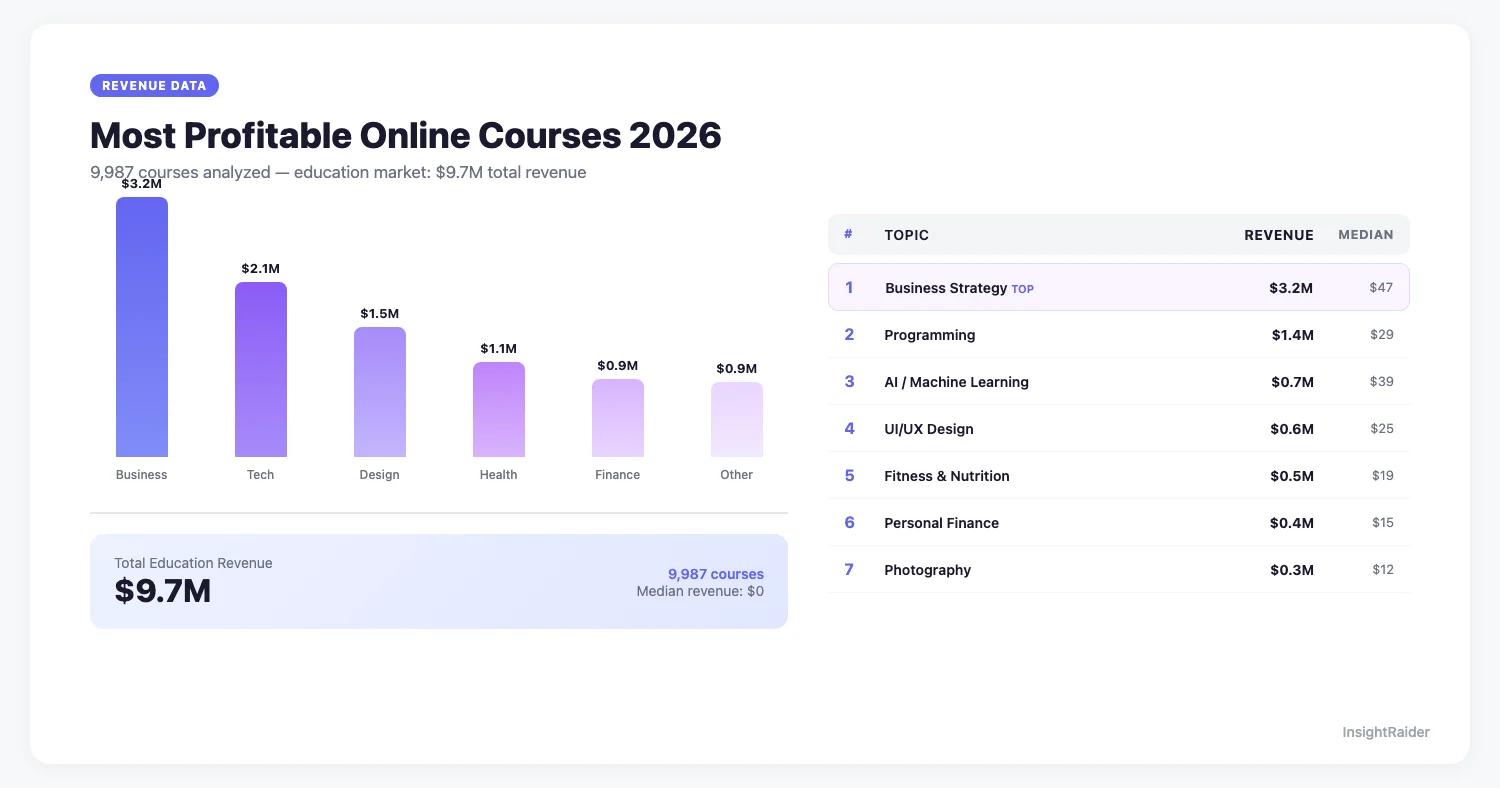
Education is a $9.7 million category on Gumroad alone, by InsightRaider's modeled estimate. That sounds promising, until you dig in.
Our stored Gumroad snapshot of the Education category holds 9,701 products from 4,121 sellers, with $9.7M in modeled revenue. That is about $1,004 per product on average, and an average in a top-heavy category hides a long tail of listings that barely sell.
But that's not a reason to avoid courses. It's a reason to study what separates the top sellers from the courses that earn nothing.
The State of Online Courses: Raw Numbers
| Metric | Value |
|---|---|
| Products in snapshot | 9,701 |
| Sellers in snapshot | 4,121 |
| Total modeled revenue | $9.7M |
| Average modeled revenue per product | $1,004 |
| Average modeled revenue per seller | $2,364 |
| Average rating | 4.82 / 5 |
These are InsightRaider modeled estimates from a stored Gumroad snapshot, not audited sales; see the estimation methodology for how revenue is modeled.
One number jumps out: $2,364 average modeled revenue per seller. In a category where a few large sellers carry much of the total, that average is a benchmark to compare against, not a typical result. Education also has a natural fit with recurring revenue. More on that later.
The Most Profitable Course Niches
Not all course topics are equal. When you break education down by sub-niche, the buyers, price tolerance and competition change a lot.
Software Development Courses
The strongest category by modeled revenue. In our snapshot, the Software Development category (which mixes courses with tools, templates and code) averages about $8,325 in modeled revenue per product across 8,044 products. The audience is large, willing to pay premium prices, and actively searching for skill upgrades.
What sells: Full-stack web development, specific framework deep dives (React, Python, DevOps), and career-switching bootcamp-style courses. The key is specificity. "Learn to Code" is a commodity. "Build a SaaS with Next.js and Stripe" tells the buyer exactly what they will ship.
Example angle: A course focused on a specific stack, like a "Full-Stack React + Node.js" deep dive, follows the pattern that works: narrow the technology, widen the audience by promising a concrete outcome.
Business & Money Courses
A large revenue pool. In our snapshot, the Business & Money category (courses, templates and guides combined) holds 9,294 products and $17.8M in modeled revenue, about $1,919 per product. That average hides a wide split between a few breakout offers and many listings that barely sell.
What sells: Courses with concrete financial outcomes. "How to Land Your First 3 Freelance Clients" gives a buyer a reason to pay that "Introduction to Freelancing" does not. The more specific the outcome in the title, the easier the course is to sell.
The sub-niche breakdown that matters:
| Business Sub-Niche | Outcome Buyers Pay For |
|---|---|
| Freelancing & client acquisition | First clients, higher rates |
| Ecommerce & dropshipping | A live store and first orders |
| Investing & trading | A repeatable process with clear risk rules |
| SaaS & micro-startups | A shipped product and first paying users |
| Productized services | A packaged offer with a fixed price |
Strong business course titles share a pattern: they promise a specific outcome in a specific timeframe for a specific audience. "How to build a freelance copywriting business in 90 days" is a much clearer offer than "Freelancing 101".
Creative Skills Courses
Design, illustration, 3D modeling, and music production. The audience is loyal to its tools, and buyers who trust a creator's workflow can come back for the next tool-specific product.
What sells: Tool-specific mastery is easier to sell than general creative theory. Our 2026 niche breakdown shows how the creative categories compare with the rest of Gumroad.
The sub-niche breakdown (example course angles):
| Creative Sub-Niche | Example Course Angle |
|---|---|
| Blender tutorials & workflows | Hard-surface modeling for game assets |
| Procreate technique courses | A brush workflow for comic inking |
| Figma & UI/UX design | Building a design system for a SaaS dashboard |
| Music production (Ableton, FL Studio) | Mixing vocals in FL Studio |
| Photography & Lightroom | An editing workflow for wedding photographers |
Real example: Jingsketch (Procreate) appears twice among the top products in our Drawing & Painting snapshot: a Procreate brush collection with 3,380 ratings and an All Access+ bundle with 1,971 ratings. Both sit in a single niche. The strategy: go deep in one tool, build a catalog, let the ratings compound.
The Pricing Sweet Spot
Price is the lever most course creators underuse.
InsightRaider's model puts the optimal price point for the Education category at $150 in our stored snapshot (a modeled estimate, not a controlled price test). A course priced under $20 has to sell a lot of copies just to cover the time it takes to support and update it.
And price is not only about margin. The price itself is a signal. A $19 course says "this is a side project." A $149 course says "this is a serious investment in your skills." Buyers treat them accordingly.
For the full pricing framework, see our digital product pricing strategies breakdown.
How to Price Your Course
| Price Range | What It Signals | Best For |
|---|---|---|
| Under $20 | "Quick resource" | Lead magnets, mini-courses, list builders |
| $20-$49 | "Solid content" | Single-topic tutorials, workshops |
| $50-$99 | "Comprehensive" | Multi-module courses with exercises |
| $100-$199 | "Professional" | Full curriculum, certification-style |
| $200+ | "Premium transformation" | Cohort-based, mentorship, career outcomes |
A practical starting range for solo creators is $97-$149. High enough to signal quality. Low enough to be an easy decision for professionals investing in their careers. Treat it as a starting assumption to test with your own buyers, not a measured optimum.
Three Tactics That Move the Revenue Needle
The patterns from our digital product market research guide apply doubly to courses. Three stand out as especially relevant for education:
Tactic 1: Tiered Pricing
Offer 2-3 tiers: course-only, course + templates + community, and a premium tier with 1-on-1 access. A premium tier lets the buyers who want more access pay for it, without raising the price for everyone else. Don't leave that money on the table.
Tactic 2: Your Description Is Your Sales Page
Your Gumroad listing needs to do the selling: module breakdowns, learning outcomes, who it's for, who it's not for, and concrete results students can expect. A 200-word description is a flyer on a bulletin board. A detailed listing is a one-on-one conversation with the buyer.
Tactic 3: PWYW as a Funnel (Not a Pricing Strategy)
Offer a mini-course or intro module as Pay What You Want to build your email list and Gumroad ratings. Then sell your premium course at a fixed $99-$199 to the audience you've built.
The Subscription Opportunity
Courses have a natural fit with recurring revenue. They come with built-in subscription models:
- Monthly content drops: New lessons, updated materials, fresh case studies
- Community access: Ongoing forums, live Q&As, peer groups
- Tool updates: For software-related courses, keeping content current is inherently recurring
- Coaching layers: Monthly group coaching calls on top of self-paced content
Subscription courses solve the creator's biggest problem: the revenue rollercoaster. Instead of launching, spiking, and crashing, you build predictable monthly recurring revenue.
The opening: If your ongoing content saves learners real time or money, there is room to test a premium subscription at $49-99/month instead of defaulting to a low monthly price.
How to Choose Your Course Topic
Forget what you "want" to teach. Start with what the market wants to learn.
Step 1: Pick a proven category. Software development and business rank among the highest-revenue categories in InsightRaider's modeled estimates, and creative tools have loyal, tool-specific buyers. Don't invent a new category unless you have an audience already waiting for it.
Step 2: Go specific. "Learn Python" is a commodity. "Python for Data Analysts Who Want to Automate Excel Reports" is a niche with hungry buyers. Specificity signals expertise and attracts people ready to pay.
Step 3: Validate with demand data. A useful rule of thumb (a heuristic, not a measured threshold): look for niches where the top 3 products show $5K+ in estimated revenue each and total product count is under 100. That's a healthy market with room for new entrants.
Step 4: Check the competition. Use InsightRaider's niche explorer to compare how many products exist in your target niche, what they charge, and their modeled revenue estimates. If the top 3 competitors all show $10K+ in estimated revenue and there are fewer than 50 products total, that's a signal worth testing.
Step 5: Design for a catalog. In the State of Gumroad 2026 dataset (InsightRaider modeled estimates), sellers with 11+ products average 5,201 total sales, versus 269 for single-product sellers. Your first course should be the entry point to a series, not a standalone. Plan 3-5 courses in the same niche before you launch the first one.
Topics to Avoid
Avoid these patterns:
- Generic "how to" courses with no specific outcome or audience
- Topics with zero existing competitors: that usually means zero demand, not a gap
- Anything priced under $20 unless it's explicitly a lead magnet for a premium course
The Action Plan
Here's the playbook:
- Pick a niche in software, business, or creative tools, where buyers already pay to learn skills
- Price at $99+ and use 2-3 tiers to capture different buyer segments
- Write a 5,000+ character sales page with module breakdowns, outcomes, and social proof
- Create 2-3 professional cover images and a preview video
- Consider PWYW for a mini-course to build your audience first
- Plan for subscriptions: add a monthly membership layer with ongoing content
- Build a catalog: one course is a lottery ticket, five courses is a business
The education market isn't saturated. It's top-heavy. And that means there's room for creators who understand the data and price accordingly.
If you're selling courses on Systeme.io or Whop, our platform-specific analytics guides show you exactly which metrics to track: Systeme.io analytics for funnel-based sellers, Whop analytics for membership-based creators.
Want to compare course niches before you build? InsightRaider compares niches by demand, modeled revenue and competition using dated observations on Gumroad, Whop and Skool. See the features.
Got more questions? Check out our data-driven answers: